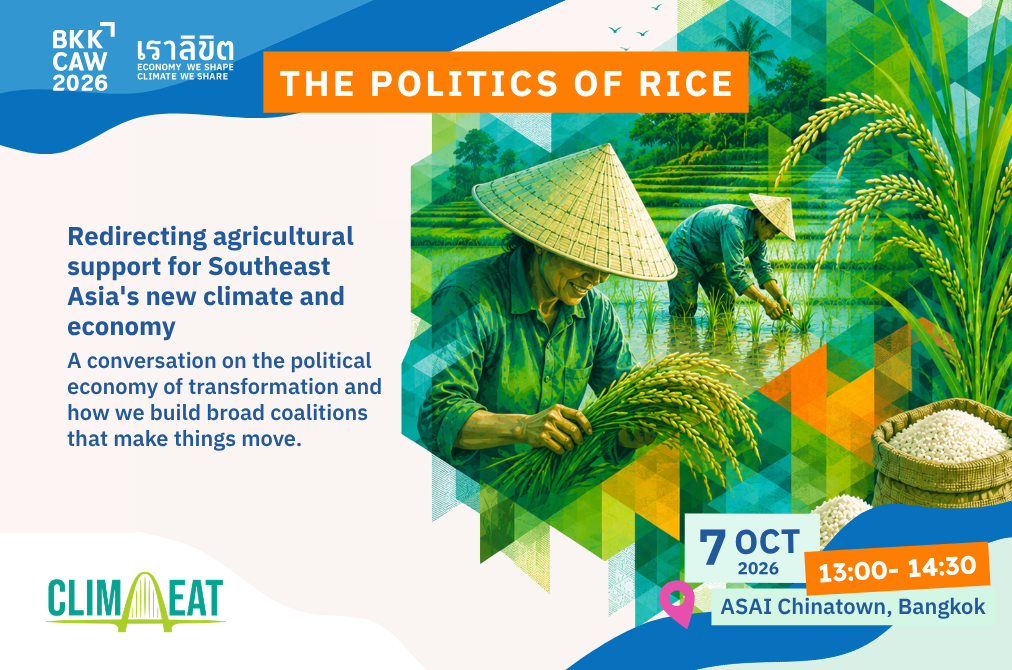
The Politics of Rice: Redirecting Agricultural Support for Southeast Asia's New Climate and Economy
07/10/2026
13:00 - 14:30
ASAI Chinatown
View on Google MapsAbout this event
Every day, governments around the world spend more than $2 billion on agricultural subsidies, roughly 1% of global GDP. In Southeast Asia, rice sits at the heart of these expenditures: a crop with profound political significance, embedded in national food sovereignty narratives, and backed by some of the most entrenched subsidy systems in the world. The region produces around a quarter of the world's rice supply, and the climate cost of that production is substantial (Project Drawdown, 2025). Rice cultivation generates nearly 300 million tons of CO2-equivalent emissions in Southeast Asia annually, contributing to a global picture in which rice accounts for approximately 9% of all anthropogenic methane and 10% of cropland nitrous oxide emissions (Wang et al., 2020). Global methane from rice production stands at 0.8 to 1.0 Gt CO2-equivalent per year and is growing (Jackson et al., 2024; Nabuurs et al., 2022). Conventional input subsidy regimes actively reinforce this trajectory, incentivizing practices that sustain emissions, degrade soils, and entrench farmer dependency on inputs. Yet for all this public spending, smallholder rice farmers capture only a fraction of the value. The bulk accrues to millers, input suppliers, and trading enterprises, actors with the political leverage to shape policy in their favour and strong incentives to resist change. The case for repurposing this public support is not contested. Redirecting it toward climate-smart practices, farmers' livelihoods, and sustainable food systems is increasingly well-evidenced. For example, repurposed subsidies could catalyze farmer uptake of proven emissions-reduction practices, from alternate wetting and drying techniques to improved seed varieties and precision nutrient management, innovations that exist but currently lack the financial incentives to scale. What is missing is not better policy design, nor the technologies themselves. What is missing is a clear understanding of the political and narrative conditions that make reform viable, and a regional coalition prepared to act on it. The High-Level Panel for a Just Rural Transition, convened by Clim-Eat under the Voices for Just Rural Transitions initiative and chaired by former President of Costa Rica H.E. Carlos Alvarado Quesada, has been developing precisely that understanding. Its work examines how actors, institutions, and narratives interact to block or enable reform, and what coalitions and strategies can shift that balance. This event brings the Panel's work into the room at a critical moment: one week before the IMF/World Bank Annual Meetings in Bangkok, and with COP31 in Turkey on the horizon. The purpose is not to broadcast a finished message but to co-develop and stress-test different messages. Therefore, the event will be hosted under Chatham House Rule, to facilitate a trusted and open environment. The event is part of the Bangkok Climate Action Week Food Systems Cluster, with the theme: Food systems that work for all - people, nature, culture, and future”. The 7th of October is the dedicated day for a range of events around rice, all taking place at the ASAI Bangkok Chinatown (531 Charoen Krung Road, Bangkok, TH 10100).