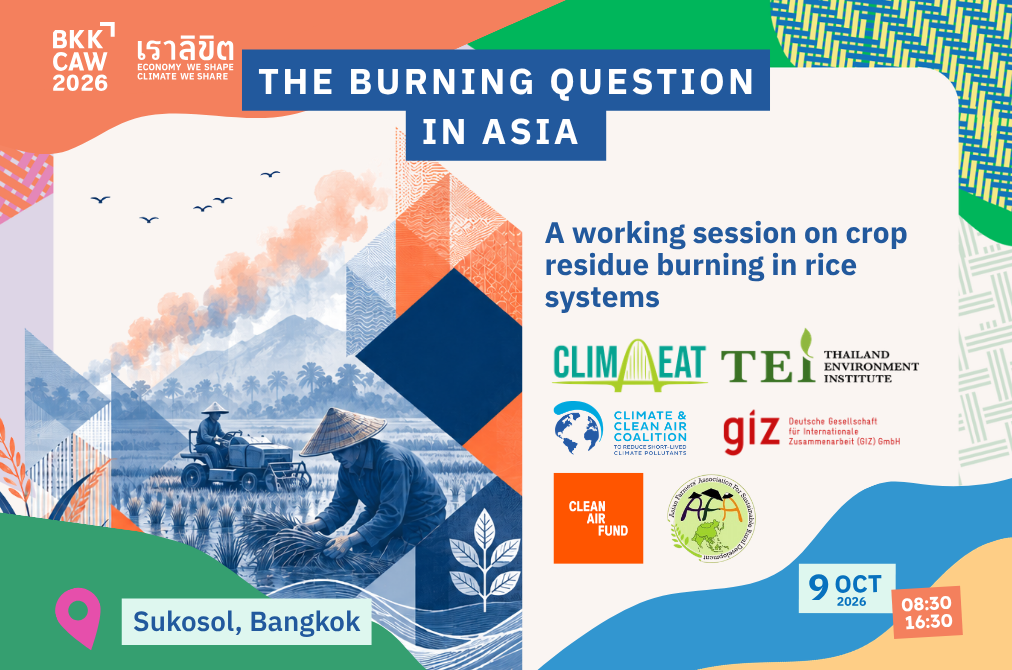
The burning question in Asia: A working session on crop residue burning in rice systems
09/10/2026
08:30 - 16:30
Sukosol Hotel
View on Google MapsAbout this event
Across Asia, the rice harvest is followed almost immediately by fire. Farmers burn crop residue to clear fields before the next planting window opens. It is fast, cheap, and effective for that purpose. It is also one of the most significant sources of agricultural black carbon in the region, producing seasonal haze events that affect hundreds of millions of people and contribute to measurable health burdens across South and Southeast Asia. Most ASEAN countries have regulations prohibiting open burning of agricultural residues. Outside Southeast Asia, India has introduced satellite monitoring and financial penalties for farmers who burn, and China has combined enforcement with subsidies for residue-return machinery. Yet satellite data consistently shows burning persisting at scale. In Punjab, in the Mekong Delta, in Central Luzon, the practice continues because the economics have not changed: burning remains the fastest and cheapest way to solve a logistical problem within a tight planting schedule. Some, rightly alarmed by the scale of the public health burden, push for stronger enforcement and stricter bans. However, agriculture specialists, air quality advocates and farmer organisations point out that bans without viable alternatives simply transfer costs onto farmers, and that no-burn alternatives are only adopted where they match burning on speed and cost, or where a functioning market for the residue exists. Technologies that exist often lack viability at smallholder level. The burning question is: what combination of technologies, incentives, markets and enforcement can actually change the calculation for farmers?