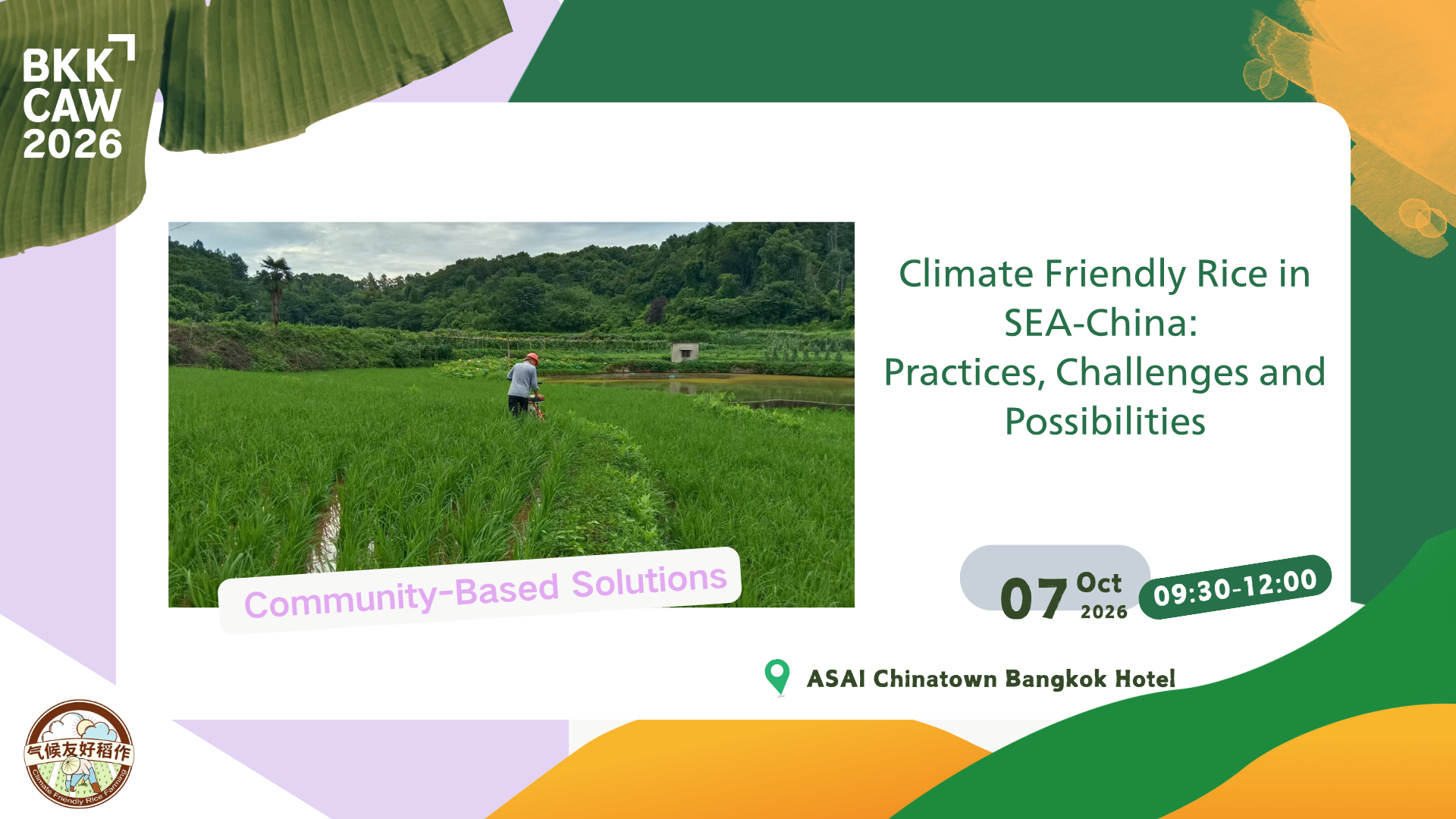
Climate Friendly Rice in SEA-China: Practices, Challenges and Possibilities
07/10/2026
09:30 - 12:00
ASAI Chinatown Bangkok Hotel
About this event
Community-based solutions from NGOs and farmers Rice exhibition Panel discussion from practitioners and researchers The frequency, intensity, and duration of extreme heat events have risen sharply over the past half-century, and the risks to agri-food systems and ecosystems are set to soar in the future, according to the latest joint report from the Food and Agriculture Organization of the United Nations (FAO) and the World Meteorological Organization (WMO). Rice, the world’s most in-demand staple crop, is not only vulnerable to climate change but also exacerbates it, as traditional cultivation methods generate substantial quantities of methane, a potent greenhouse gas. Additionally, its highly water-intensive nature poses a formidable challenge to an increasingly arid planet. Currently, climate-friendly rice farming is shifting from a single technology focused on reducing methane emissions from paddy fields to a comprehensive approach that balances emissions reduction, adaptation, food security. Although international agricultural climate policies emphasize, at the value level, the importance of farmers’ livelihoods, food security, and the role of vulnerable groups and smallholder farmers in climate adaptation, key challenges in implementation remain: whether smallholder farmers can truly participate, how to mitigate the risks associated with technology transition, and how to provide incentives for them to benefit. This also creates opportunities for NGOs, community networks, and local knowledge producers to play a meaningful role. In China, many NGOs have taken climate-friendly rice as a starting point, integrating traditional agricultural wisdom with modern scientific and technological advancements to explore technical systems and practical guidelines tailored to diverse production entities, ranging from large-scale commercial farms to family farms and smallholder households. By conducting pilot demonstrations across multiple provinces and providing training on concepts and techniques, these organizations are actively promoting the localized implementation and nationwide adoption of climate-friendly rice farming technologies. China and the rice-growing regions of SEA share similar climate challenges, such as high temperatures, droughts, floods, and water resource stress, while differing in policy, market mechanisms, and governance. Their respective localized practices can provide a case-based foundation for inter-regional exchange and knowledge sharing, while also seeking an opportunity to develop SEA-China climate-friendly rice network.