Programme
79 Programme found
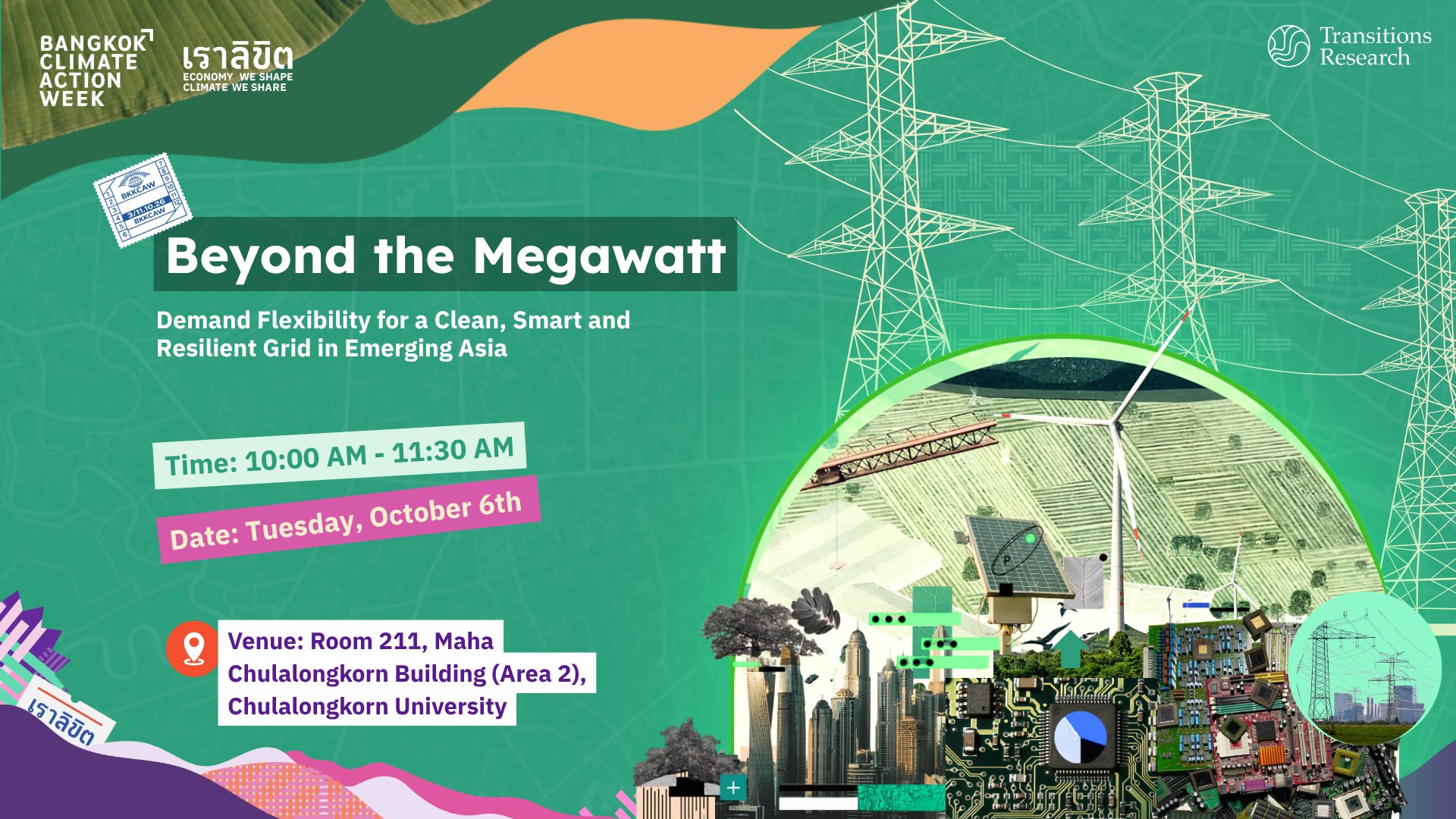
Beyond the Megawatt: Demand Flexibility for a Clean, Smart and Resilient Grid in Emerging Asia
A sustainable energy transition is not only a question of building more renewable generation or modernising electricity grids. It also depends on how consumers use electricity, respond to prices and grid signals, and whether they are able and willing to participate in a more flexible energy system. Demand flexibility, the ability to shift or adjust electricity use in response to grid conditions or prices, can help integrate more renewables, reduce solar curtailment and maintain grid stability and reliability. Scaling it, would require enabling technologies, appropriate market incentives, supportive regulatory frameworks and consumer trust and participation. Drawing on experiences from India and Southeast Asia, this panel discussion will examine how market design, tariff structures, smart appliances, and different levels of demand-side response can unlock greater grid flexibility. It will explore how consumers can become active participants in the energy transition rather than simply end-users of electricity. The discussion will identify key enablers for scaling demand flexibility, facilitate regional learning and collaboration, and generate actionable policy recommendations and position demand flexibility as a critical enabler of Asia’s clean energy transition.
06/10/2026 • 10:00
Room 211, Maha Chulalongkorn Building (Area 2), Chulalongkorn University
Beyond the Megawatt: Demand Flexibility for a Clean, Smart and Resilient Grid in Emerging Asia
A sustainable energy transition is not only a question of building more renewable generation or modernising electricity grids. It also depends on how consumers use electricity, respond to prices and grid signals, and whether they are able and willing to participate in a more flexible energy system. Demand flexibility, the ability to shift or adjust electricity use in response to grid conditions or prices, can help integrate more renewables, reduce solar curtailment and maintain grid stability and reliability. Scaling it, would require enabling technologies, appropriate market incentives, supportive regulatory frameworks and consumer trust and participation. Drawing on experiences from India and Southeast Asia, this panel discussion will examine how market design, tariff structures, smart appliances, and different levels of demand-side response can unlock greater grid flexibility. It will explore how consumers can become active participants in the energy transition rather than simply end-users of electricity. The discussion will identify key enablers for scaling demand flexibility, facilitate regional learning and collaboration, and generate actionable policy recommendations and position demand flexibility as a critical enabler of Asia’s clean energy transition.
06/10/2026 • 10:00
Room 211, Maha Chulalongkorn Building (Area 2), Chulalongkorn University
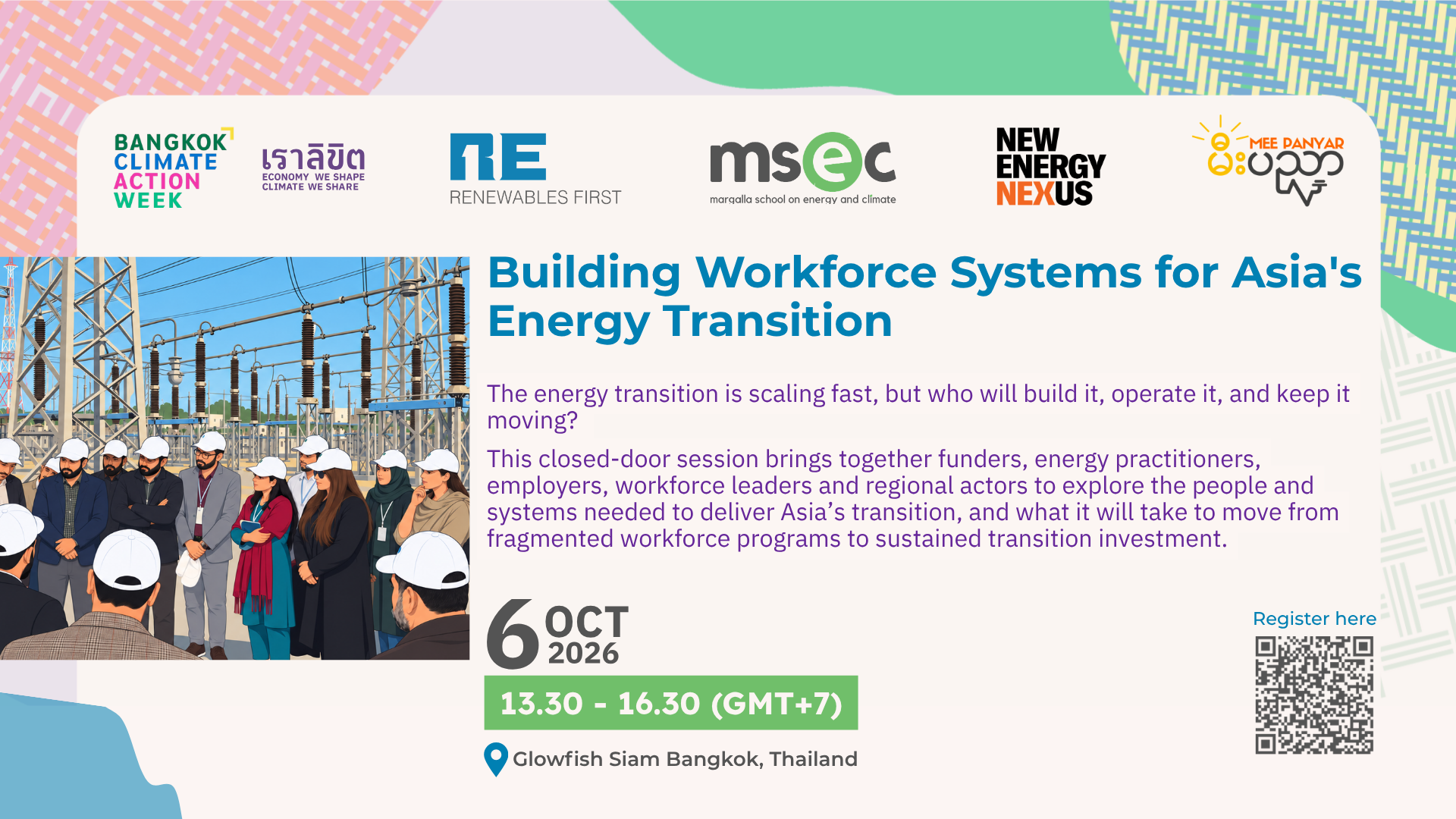
Building Workforce Systems for Asia's Energy Transition
The energy transition across South and Southeast Asia is accelerating rapidly. Investment in renewable energy, grid modernization, electrification, and other transition-related technologies continues to grow, becoming increasingly central to regional development and economic priorities. At the same time, international organizations including IRENA, the IEA, and the ILO have highlighted growing workforce and skills requirements associated with the scale of the transition. As new occupations emerge across renewable energy, grid modernization, energy planning, climate finance, and related sectors, workforce systems are under increasing pressure to respond to evolving industry needs. Across the region, countries are confronting shortages in implementation-ready talent, evolving skills requirements, and limited coordination between employers, workforce institutions, and transition practitioners. While significant resources are being directed toward technology deployment and infrastructure development, comparatively less attention is being paid to the workforce systems, learning pathways, and institutional coordination needed to support long-term implementation. This challenge is particularly visible in distributed and decentralized energy systems, where much of the workforce involved in installation, operations, and maintenance remains informal, project-based, or insufficiently reflected in workforce planning processes. As countries scale energy transitions, understanding and supporting the full diversity of transition workers, from technicians and installers to planners and policy practitioners becomes increasingly important for ensuring resilient and inclusive outcomes. This event brings together philanthropy, workforce institutions, employers, implementation actors, and ecosystem partners to explore how workforce systems and institutional readiness can evolve alongside the pace of the energy transition.
06/10/2026 • 13:30
Glowfish Siam
Building Workforce Systems for Asia's Energy Transition
The energy transition across South and Southeast Asia is accelerating rapidly. Investment in renewable energy, grid modernization, electrification, and other transition-related technologies continues to grow, becoming increasingly central to regional development and economic priorities. At the same time, international organizations including IRENA, the IEA, and the ILO have highlighted growing workforce and skills requirements associated with the scale of the transition. As new occupations emerge across renewable energy, grid modernization, energy planning, climate finance, and related sectors, workforce systems are under increasing pressure to respond to evolving industry needs. Across the region, countries are confronting shortages in implementation-ready talent, evolving skills requirements, and limited coordination between employers, workforce institutions, and transition practitioners. While significant resources are being directed toward technology deployment and infrastructure development, comparatively less attention is being paid to the workforce systems, learning pathways, and institutional coordination needed to support long-term implementation. This challenge is particularly visible in distributed and decentralized energy systems, where much of the workforce involved in installation, operations, and maintenance remains informal, project-based, or insufficiently reflected in workforce planning processes. As countries scale energy transitions, understanding and supporting the full diversity of transition workers, from technicians and installers to planners and policy practitioners becomes increasingly important for ensuring resilient and inclusive outcomes. This event brings together philanthropy, workforce institutions, employers, implementation actors, and ecosystem partners to explore how workforce systems and institutional readiness can evolve alongside the pace of the energy transition.
06/10/2026 • 13:30
Glowfish Siam
CDx Summit 2026: Accelerating Decarbonization for Southeast Asia in an Uncertain World
The CDx Summit 2026 is the annual flagship event of the Southeast Asia Corporate Decarbonization Exchange (CDx), a regional membership-based platform that equips businesses with the knowledge, networks, and tools to take credible decarbonization action. The one-day event brings together businesses, financiers, solution providers, industry associations, and development partners to address the practical challenges facing Southeast Asia's corporate sector. The program combines three signature CDx formats — Townhall, Fishbowl, and Debate — structured across three movements: a strategic executive briefing in the morning, subject-matter fishbowl sessions on pressing topics at midday, and a community co-creation block in the afternoon introducing CDx's next phase of development, including the CDx Academy, CDx Finance Bridge, and a rapid corporate diagnostic tool. The event is free to attend and open to all stakeholders engaged in Southeast Asia's low-carbon transition.
06/10/2026 • 09:00
One Bangkok, Tower 4, Common 6
CDx Summit 2026: Accelerating Decarbonization for Southeast Asia in an Uncertain World
The CDx Summit 2026 is the annual flagship event of the Southeast Asia Corporate Decarbonization Exchange (CDx), a regional membership-based platform that equips businesses with the knowledge, networks, and tools to take credible decarbonization action. The one-day event brings together businesses, financiers, solution providers, industry associations, and development partners to address the practical challenges facing Southeast Asia's corporate sector. The program combines three signature CDx formats — Townhall, Fishbowl, and Debate — structured across three movements: a strategic executive briefing in the morning, subject-matter fishbowl sessions on pressing topics at midday, and a community co-creation block in the afternoon introducing CDx's next phase of development, including the CDx Academy, CDx Finance Bridge, and a rapid corporate diagnostic tool. The event is free to attend and open to all stakeholders engaged in Southeast Asia's low-carbon transition.
06/10/2026 • 09:00
One Bangkok, Tower 4, Common 6
Changing Currents: Charting our Energy Future
Imagine you are rural solar power technician and an earthquake hits your country, causing wide scale destruction. How might this impact your family and community? What will you find difficult (or impossible) to acquire because of this event? What injustices become more visible to you? What new alliances might you explore to help you stay resilient? Could you work with local government, community members, or other stakeholders to find solutions? Climate Cascade developed out of a desire to better understand how macro level events impact food systems, energy systems, and the environment, and how the ripple effects of these disruptions impact the lives of societies and individuals. In this fast-paced futures game, players take on the roles of individual citizens of an unnamed country or region. In each round, a “shock” card is pulled, and players must consider how these shocks impact individual characters while also thinking about what a character might do differently because of the shock. What this means for individual players may be unique, but everyone comes from the same place, and disruptions that happen in this game will happen to everybody. In groups, players will then discuss together the collective opportunities and challenges that arise as their characters strive to build a more just and regenerative future for their societies. At the end of the session, which takes the form of facilitated gameplay, participants are invited to reflect on their takeaways: what they observed, learned, and what sparked in their imagination, and to consider how they might integrate futures thinking and collaborative problem-solving into their day-to-day roles. The objectives of the session are: › Simulate the complexity and uncertainty of the energy system and the plausible events and trends that could shape conditions and decision-making in the short- and medium-term. › Introduce participants to the concept of futures thinking and the idea that there are multiple potential, plausible, and preferred pathways and outcomes. › Build the anticipatory “muscle” of individuals and the collective. › Offer a fun, stimulating activity for people interested in the energy transition and/or in futures.
06/10/2026 • 13:00
Ivory I & II, COMO Metropolitan Bangkok
Changing Currents: Charting our Energy Future
Imagine you are rural solar power technician and an earthquake hits your country, causing wide scale destruction. How might this impact your family and community? What will you find difficult (or impossible) to acquire because of this event? What injustices become more visible to you? What new alliances might you explore to help you stay resilient? Could you work with local government, community members, or other stakeholders to find solutions? Climate Cascade developed out of a desire to better understand how macro level events impact food systems, energy systems, and the environment, and how the ripple effects of these disruptions impact the lives of societies and individuals. In this fast-paced futures game, players take on the roles of individual citizens of an unnamed country or region. In each round, a “shock” card is pulled, and players must consider how these shocks impact individual characters while also thinking about what a character might do differently because of the shock. What this means for individual players may be unique, but everyone comes from the same place, and disruptions that happen in this game will happen to everybody. In groups, players will then discuss together the collective opportunities and challenges that arise as their characters strive to build a more just and regenerative future for their societies. At the end of the session, which takes the form of facilitated gameplay, participants are invited to reflect on their takeaways: what they observed, learned, and what sparked in their imagination, and to consider how they might integrate futures thinking and collaborative problem-solving into their day-to-day roles. The objectives of the session are: › Simulate the complexity and uncertainty of the energy system and the plausible events and trends that could shape conditions and decision-making in the short- and medium-term. › Introduce participants to the concept of futures thinking and the idea that there are multiple potential, plausible, and preferred pathways and outcomes. › Build the anticipatory “muscle” of individuals and the collective. › Offer a fun, stimulating activity for people interested in the energy transition and/or in futures.
06/10/2026 • 13:00
Ivory I & II, COMO Metropolitan Bangkok
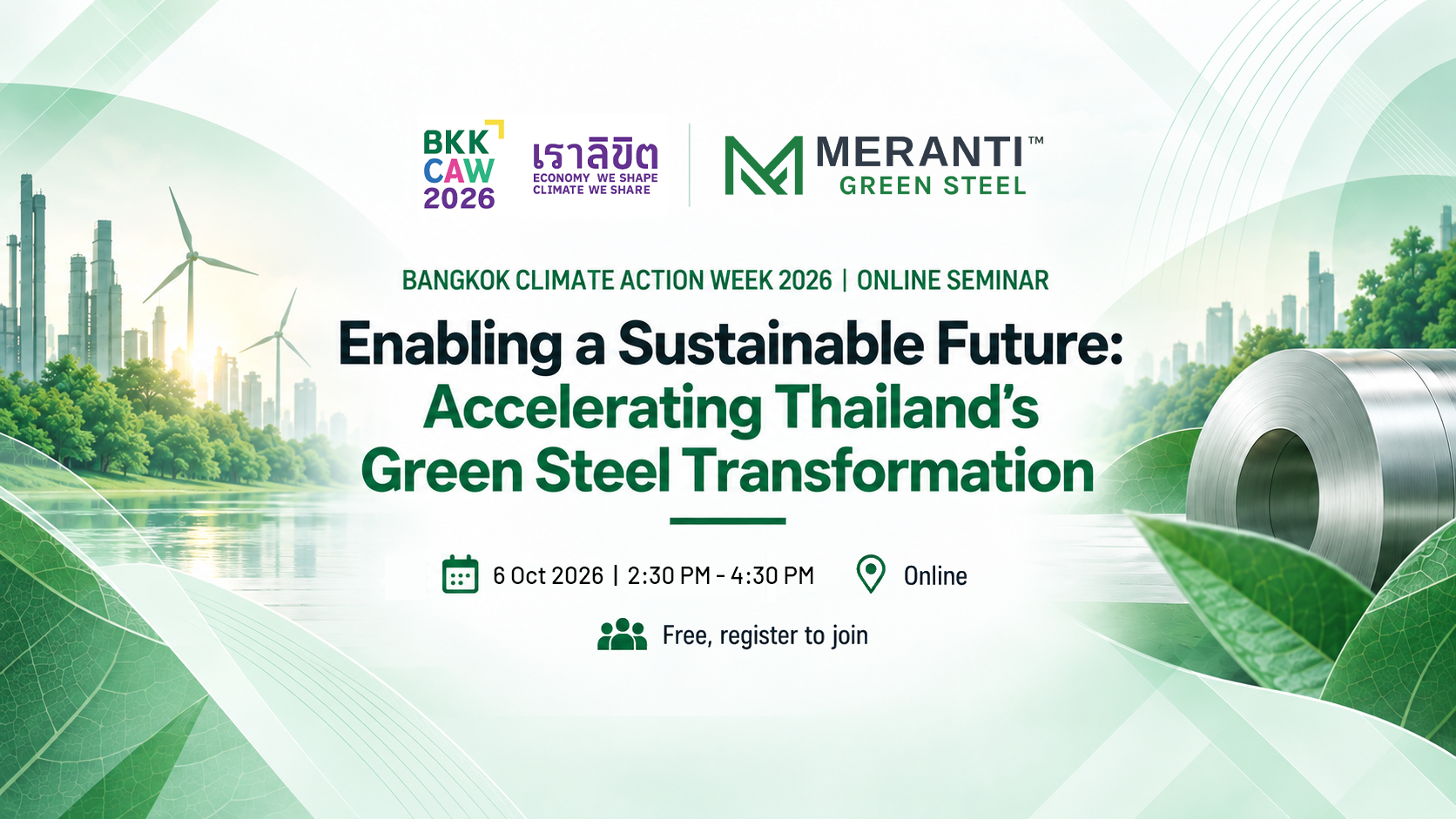
Enabling a Sustainable Future: Accelerating Thailand’s Green Steel Transformation
As Thailand moves towards its climate and Net Zero ambitions, transforming carbon-intensive industries will be essential to building a more sustainable and competitive economy. This online session will explore the role of green steel in Thailand’s industrial transition, looking at how innovation, technology, commercially viable business models and credible sustainability strategies can help accelerate the decarbonization of the steel value chain. Drawing on perspectives from across the green steel ecosystem, the discussion will examine both the opportunities and challenges involved in reducing industrial emissions, from understanding the fundamentals of green steel and its evolving value chain to addressing carbon footprints and embedding sustainability into business and investment decisions. The session will also consider the broader role of Thailand’s manufacturing sectors—including steel, automotive and construction—in supporting the country’s transition towards Net Zero, and the collaboration needed across industry, government and the wider ecosystem to turn climate ambition into practical action.
06/10/2026 • 14:30
Meranti Green Steel Office [Online]
Enabling a Sustainable Future: Accelerating Thailand’s Green Steel Transformation
As Thailand moves towards its climate and Net Zero ambitions, transforming carbon-intensive industries will be essential to building a more sustainable and competitive economy. This online session will explore the role of green steel in Thailand’s industrial transition, looking at how innovation, technology, commercially viable business models and credible sustainability strategies can help accelerate the decarbonization of the steel value chain. Drawing on perspectives from across the green steel ecosystem, the discussion will examine both the opportunities and challenges involved in reducing industrial emissions, from understanding the fundamentals of green steel and its evolving value chain to addressing carbon footprints and embedding sustainability into business and investment decisions. The session will also consider the broader role of Thailand’s manufacturing sectors—including steel, automotive and construction—in supporting the country’s transition towards Net Zero, and the collaboration needed across industry, government and the wider ecosystem to turn climate ambition into practical action.
06/10/2026 • 14:30
Meranti Green Steel Office [Online]
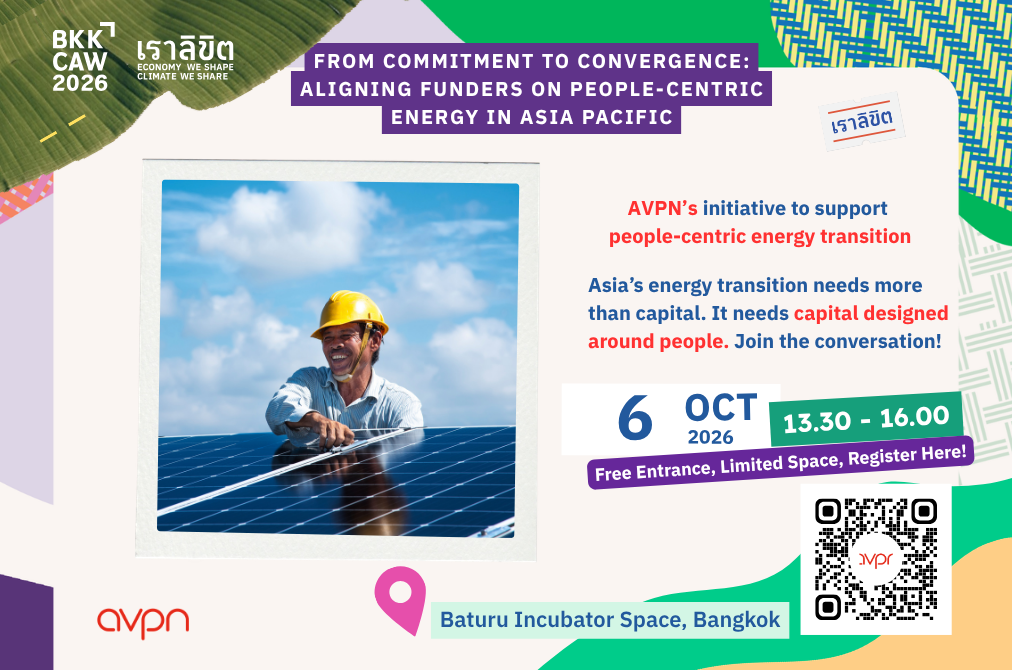
From Commitment to Convergence: Aligning Funders on People-Centric Energy in Asia Pacific
The energy transition in Asia Pacific is accelerating, but funding often fails to reach the communities, workers, and small enterprises most affected. Building on ASCENT’s shared framework and principles, this session brings funders, community voices, and project owners together to explore practical financing solutions. The panel will examine barriers on the ground and how philanthropy, commercial capital, and underexplored sources such as faith-based giving can provide complementary support. Interactive project showcases will highlight real funding needs and implementation challenges, helping participants identify opportunities for coordinated funding and collaboration to advance a people-centric energy transition across the region Key takeaways - Understand the priorities and funding barriers communities and project owners face. - Explore how philanthropy, commercial capital, and under-explored sources can provide complementary support. - Identify practical opportunities for coordinated funding and collaboration through project showcases and AVPN’s initiative to support people-centric energy transition. Notes: Please note that guests need to register via Luma and receive confirmation before attending.
06/10/2026 • 13:30
Baturu Incubator Space
From Commitment to Convergence: Aligning Funders on People-Centric Energy in Asia Pacific
The energy transition in Asia Pacific is accelerating, but funding often fails to reach the communities, workers, and small enterprises most affected. Building on ASCENT’s shared framework and principles, this session brings funders, community voices, and project owners together to explore practical financing solutions. The panel will examine barriers on the ground and how philanthropy, commercial capital, and underexplored sources such as faith-based giving can provide complementary support. Interactive project showcases will highlight real funding needs and implementation challenges, helping participants identify opportunities for coordinated funding and collaboration to advance a people-centric energy transition across the region Key takeaways - Understand the priorities and funding barriers communities and project owners face. - Explore how philanthropy, commercial capital, and under-explored sources can provide complementary support. - Identify practical opportunities for coordinated funding and collaboration through project showcases and AVPN’s initiative to support people-centric energy transition. Notes: Please note that guests need to register via Luma and receive confirmation before attending.
06/10/2026 • 13:30
Baturu Incubator Space
From Policy to Practice: How the International Climate Initiative benefits climate and biodiversity action on the ground
How do climate and biodiversity policies translate into tangible action on the ground? This event brings together policymakers, project implementers, development partners and members of the Thai public to explore how the International Climate Initiative (IKI) is supporting climate and biodiversity action in Thailand. The event will showcase the work of the IKI in Thailand and create space for mutual dialogue.
06/10/2026 • 10:00
OneBangkok Forum, Meeting Room 1
From Policy to Practice: How the International Climate Initiative benefits climate and biodiversity action on the ground
How do climate and biodiversity policies translate into tangible action on the ground? This event brings together policymakers, project implementers, development partners and members of the Thai public to explore how the International Climate Initiative (IKI) is supporting climate and biodiversity action in Thailand. The event will showcase the work of the IKI in Thailand and create space for mutual dialogue.
06/10/2026 • 10:00
OneBangkok Forum, Meeting Room 1
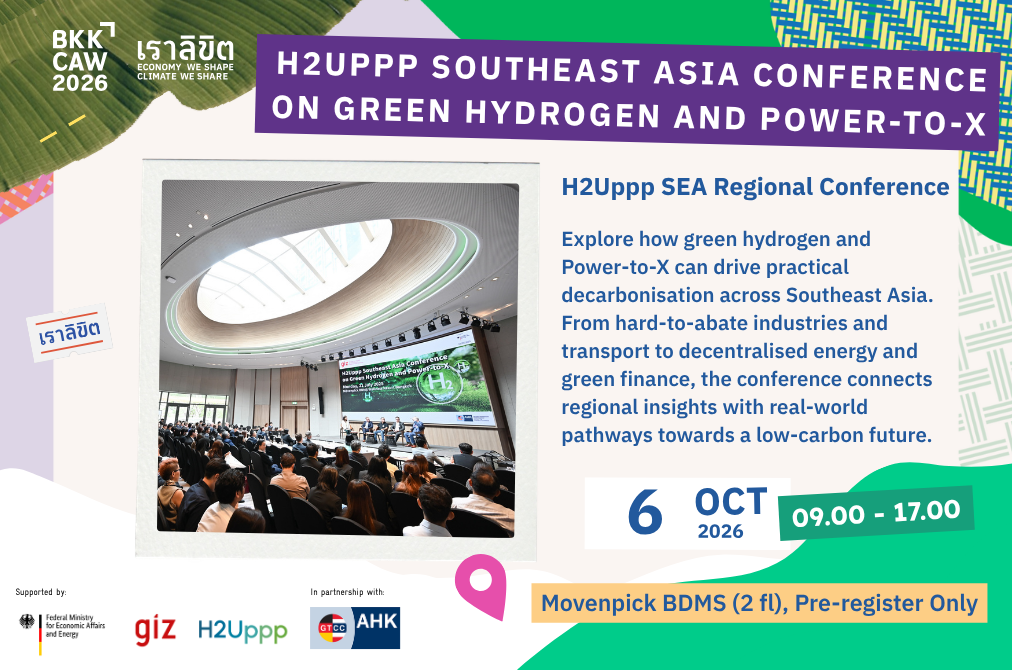
H2Uppp Southeast Asia Conference on Green Hydrogen and Power-to-X
Where is green hydrogen heading in Southeast Asia, and where can it deliver the greatest decarbonisation impact? From low-carbon industrial feedstocks and steel production to sustainable aviation, maritime shipping and decentralised energy, the H2Uppp SEA Regional Conference 2026 explores where green hydrogen and Power-to-X can deliver practical decarbonisation across the region. The programme will unpack regional hydrogen policies and market trends, alongside the technologies and applications shaping the market. It will also explore the enabling conditions for commercial deployment, including green finance, PtX bankability, carbon credits and market mechanisms. With perspectives from Thailand, Malaysia, Vietnam, Indonesia and Singapore, the conference offers a regional platform to exchange insights, explore emerging opportunities and identify practical pathways towards a unified, commercially viable and sustainable hydrogen economy across Southeast Asia. The conference is organised by the International Hydrogen Ramp-Up Programme (H2Uppp), implemented by GIZ. H2Uppp supports green hydrogen market development across Southeast Asia through European and local expertise, business networks and public-private cooperation.
06/10/2026 • 09:00
Movenpick BDMS 2nd Fl
H2Uppp Southeast Asia Conference on Green Hydrogen and Power-to-X
Where is green hydrogen heading in Southeast Asia, and where can it deliver the greatest decarbonisation impact? From low-carbon industrial feedstocks and steel production to sustainable aviation, maritime shipping and decentralised energy, the H2Uppp SEA Regional Conference 2026 explores where green hydrogen and Power-to-X can deliver practical decarbonisation across the region. The programme will unpack regional hydrogen policies and market trends, alongside the technologies and applications shaping the market. It will also explore the enabling conditions for commercial deployment, including green finance, PtX bankability, carbon credits and market mechanisms. With perspectives from Thailand, Malaysia, Vietnam, Indonesia and Singapore, the conference offers a regional platform to exchange insights, explore emerging opportunities and identify practical pathways towards a unified, commercially viable and sustainable hydrogen economy across Southeast Asia. The conference is organised by the International Hydrogen Ramp-Up Programme (H2Uppp), implemented by GIZ. H2Uppp supports green hydrogen market development across Southeast Asia through European and local expertise, business networks and public-private cooperation.
06/10/2026 • 09:00
Movenpick BDMS 2nd Fl
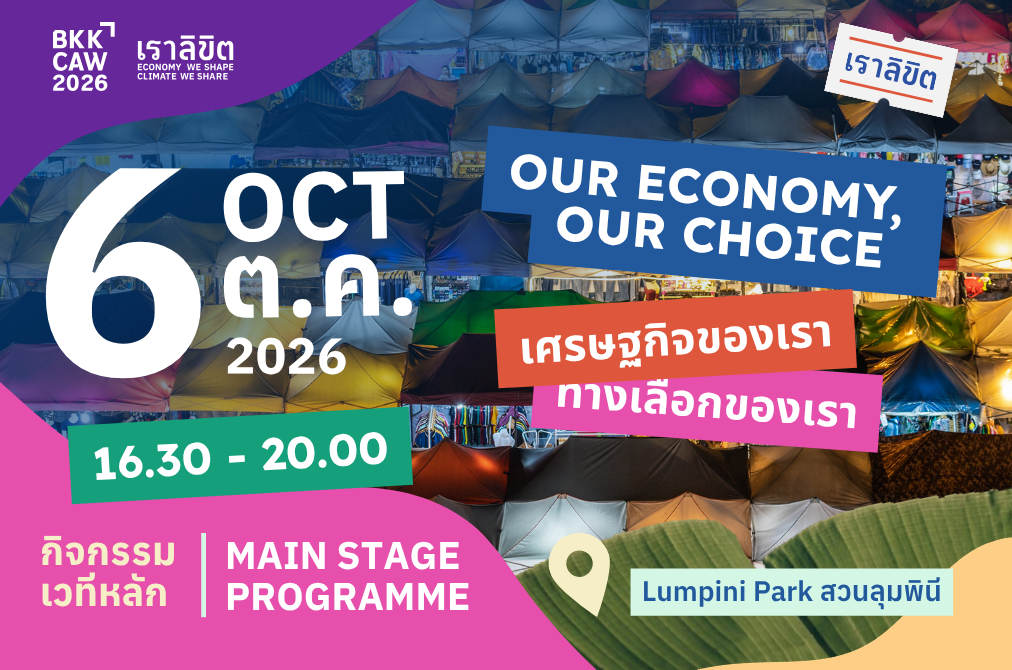
MAIN STAGE | Day 3 | Our Economy, Our Choice
A better economy is people-centered: it is inclusive, accountable to people and responsive to their priorities, and leaves no one behind. This session considers: - The central role of civil society actors - How individuals have agency beyond being consumers - How power is shifted, participation enabled, and fairness guaranteed in a people-centered economy - The skills needed to flourish in a wellbeing economy - Decolonizing our economic narratives Each evening on the main stage, we feature the following: 🎭 Art & Culture Performance (15 min) A showcase celebrating Thailand's Climate Story - 7 Regions, 1 Action. Embracing local wisdom and modern creativity. 📋 BKKCAW recap of the day (15 min) Key highlights, moments and takeaways from today's BKKCAW sessions across the city. 💬 Q&A (10 min) Your questions answered by today's speakers and programme team. 🌀 Theme Wrap-Up (10 min) Reflecting on today's panel discussions and a preview of what's coming tomorrow. 🎵 Climate Concert (1 Hour) Music, art and community energy to close the evening, where sound and culture meet climate action.
06/10/2026 • 16:30
Lumphini Park
MAIN STAGE | Day 3 | Our Economy, Our Choice
A better economy is people-centered: it is inclusive, accountable to people and responsive to their priorities, and leaves no one behind. This session considers: - The central role of civil society actors - How individuals have agency beyond being consumers - How power is shifted, participation enabled, and fairness guaranteed in a people-centered economy - The skills needed to flourish in a wellbeing economy - Decolonizing our economic narratives Each evening on the main stage, we feature the following: 🎭 Art & Culture Performance (15 min) A showcase celebrating Thailand's Climate Story - 7 Regions, 1 Action. Embracing local wisdom and modern creativity. 📋 BKKCAW recap of the day (15 min) Key highlights, moments and takeaways from today's BKKCAW sessions across the city. 💬 Q&A (10 min) Your questions answered by today's speakers and programme team. 🌀 Theme Wrap-Up (10 min) Reflecting on today's panel discussions and a preview of what's coming tomorrow. 🎵 Climate Concert (1 Hour) Music, art and community energy to close the evening, where sound and culture meet climate action.
06/10/2026 • 16:30
Lumphini Park
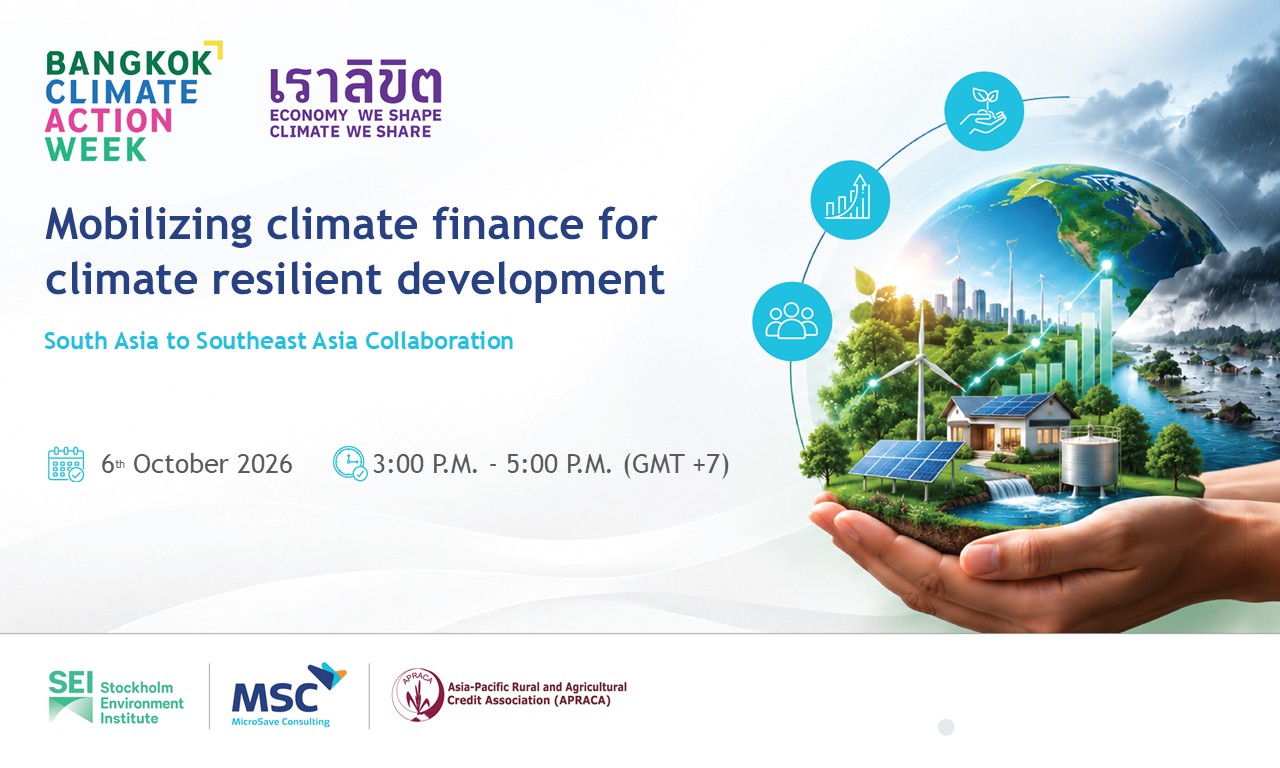
Mobilizing Climate Finance for Climate-Resilient Development: South Asia to Southeast Asia Collaboration
Adaptation finance across Asia-Pacific remains far below need, and too little reaches the communities most exposed to climate risks. Developing countries may require USD 310–365 billion annually by 2035, while international public adaptation finance was only USD 26 billion in 2023. In Asia, just 17% of international public adaptation finance between 2017 and 2021 had a specific local focus. As part of Bangkok Climate Action Week 2026, SEI(Stockholm Environment Institute), MicroSave Consulting (MSC), and APRACA (Agri-Pacific Rural Credit Association) will convene an expert-level dialogue on mobilizing inclusive climate finance for climate-resilient development, with a focus on South-South collaboration between South Asia and Southeast Asia. Drawing on evidence from the ICCAP initiative across Bangladesh, Bhutan, Cambodia, Fiji, Lao PDR, and Nepal, the discussion will explore: The session will examine what blended finance, concessional capital, guarantees, and other instruments emerging from ICCAP's work can offer toward closing the adaptation finance gap, and where South to South collaboration can accelerate that mobilization. Participants will examine which policy reforms, institutional arrangements, and financing innovations tested in Bangladesh, Bhutan, Cambodia, Fiji, Lao PDR, and Nepal can be adapted and replicated in other geographies facing similar development challenges. The session will look at the policy incentives, regulatory frameworks, and institutional arrangements needed to expand private sector participation in inclusive climate finance while keeping outcomes equitable for the communities it is meant to serve. The dialogue will bring together policymakers, regulators, financial institutions, technical experts, private-sector actors, development partners, community representatives, academia, and youth voices.
06/10/2026 • 15:00
Mobilizing Climate Finance for Climate-Resilient Development: South Asia to Southeast Asia Collaboration
Adaptation finance across Asia-Pacific remains far below need, and too little reaches the communities most exposed to climate risks. Developing countries may require USD 310–365 billion annually by 2035, while international public adaptation finance was only USD 26 billion in 2023. In Asia, just 17% of international public adaptation finance between 2017 and 2021 had a specific local focus. As part of Bangkok Climate Action Week 2026, SEI(Stockholm Environment Institute), MicroSave Consulting (MSC), and APRACA (Agri-Pacific Rural Credit Association) will convene an expert-level dialogue on mobilizing inclusive climate finance for climate-resilient development, with a focus on South-South collaboration between South Asia and Southeast Asia. Drawing on evidence from the ICCAP initiative across Bangladesh, Bhutan, Cambodia, Fiji, Lao PDR, and Nepal, the discussion will explore: The session will examine what blended finance, concessional capital, guarantees, and other instruments emerging from ICCAP's work can offer toward closing the adaptation finance gap, and where South to South collaboration can accelerate that mobilization. Participants will examine which policy reforms, institutional arrangements, and financing innovations tested in Bangladesh, Bhutan, Cambodia, Fiji, Lao PDR, and Nepal can be adapted and replicated in other geographies facing similar development challenges. The session will look at the policy incentives, regulatory frameworks, and institutional arrangements needed to expand private sector participation in inclusive climate finance while keeping outcomes equitable for the communities it is meant to serve. The dialogue will bring together policymakers, regulators, financial institutions, technical experts, private-sector actors, development partners, community representatives, academia, and youth voices.
06/10/2026 • 15:00
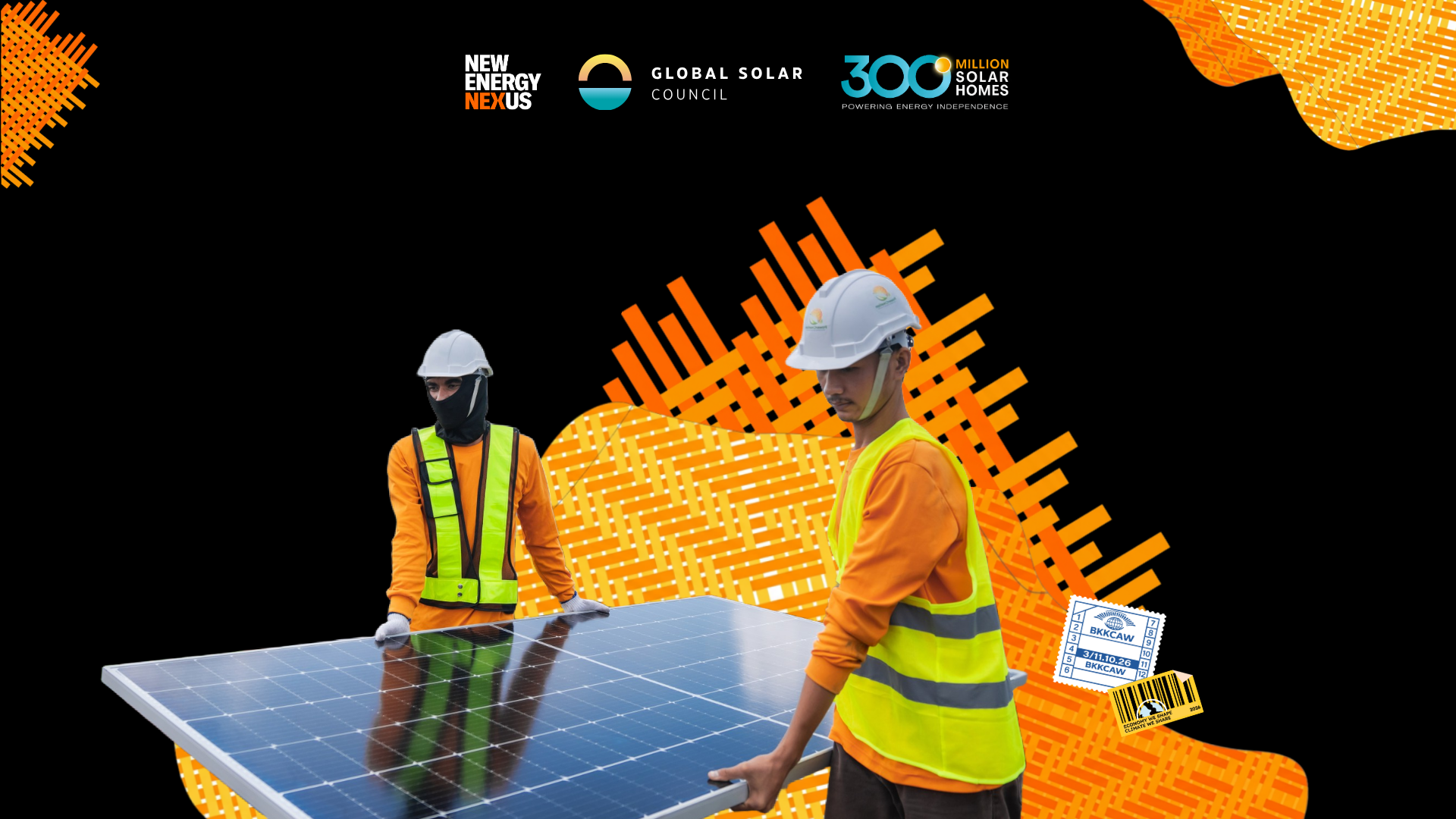
Powering Up More Solar Homes Across Southeast Asia
Solar carries more of the world's net zero ambition than any other technology, and close to half of it is being deployed on rooftops. And across Southeast Asia, rising and volatile energy costs are pushing households and businesses toward rooftop solar and storage faster than policy, finance and grid systems can respond. Join New Energy Nexus and the Global Solar Council to bring the global 300 Million Solar Homes Initiative to Bangkok for an invitation-only working session with government, utilities, solar companies, financiers and civil society. Drawing on emerging Rooftop Roadmaps and evidence from Southeast Asia and beyond, participants will hear how cities are leading the charge and where the market is stalling, from restrictive policies and slow grid connections to limited financing and uneven consumer confidence. You will spend much of the session working through those issues, sharing solutions and shaping the campaign that follows. Join us as the next phase of Southeast Asia's rooftop solar market takes shape!
06/10/2026 • 09:00
Glowfish Siam
Powering Up More Solar Homes Across Southeast Asia
Solar carries more of the world's net zero ambition than any other technology, and close to half of it is being deployed on rooftops. And across Southeast Asia, rising and volatile energy costs are pushing households and businesses toward rooftop solar and storage faster than policy, finance and grid systems can respond. Join New Energy Nexus and the Global Solar Council to bring the global 300 Million Solar Homes Initiative to Bangkok for an invitation-only working session with government, utilities, solar companies, financiers and civil society. Drawing on emerging Rooftop Roadmaps and evidence from Southeast Asia and beyond, participants will hear how cities are leading the charge and where the market is stalling, from restrictive policies and slow grid connections to limited financing and uneven consumer confidence. You will spend much of the session working through those issues, sharing solutions and shaping the campaign that follows. Join us as the next phase of Southeast Asia's rooftop solar market takes shape!
06/10/2026 • 09:00
Glowfish Siam
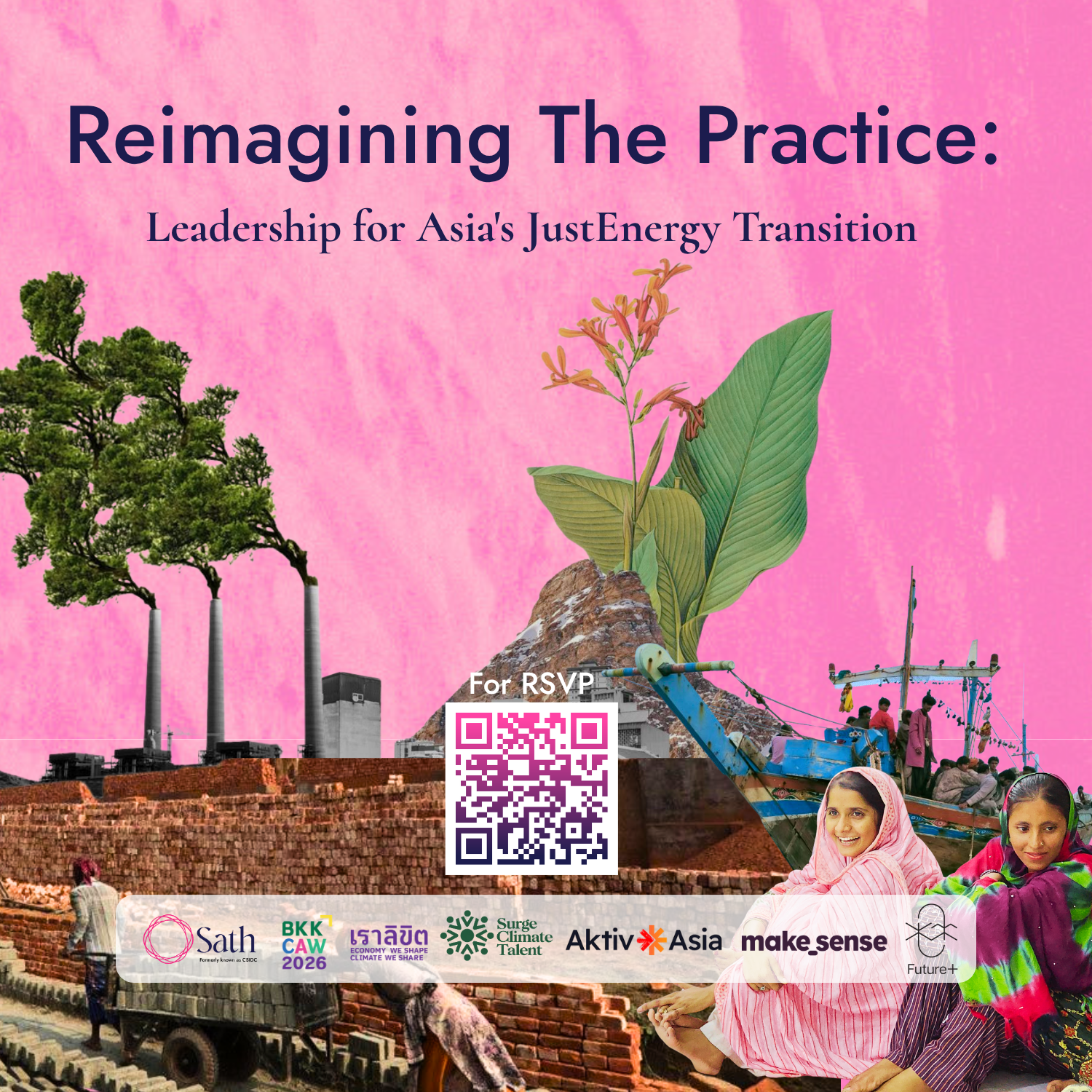
Reimagining The Practice: Leadership for Asia's Just Energy Transition
We treat leadership as a practice rather than a position. It is tacit in practice and visible in outcome. Asia's Just Energy Transition is not stalling for want of technology or capital. It is stalling on account of challenges that are fundamentally political, relational and systemic: who carries the cost, who is consulted, whether collective actions hold. That work is led, not engineered and it remains largely undocumented, especially in the Asian context. Through expert discussion and group work, this event opens the question: what is the practice of leadership that can produce Just Energy Transition outcomes across Asia, and what does it ask us to unlearn about leadership itself? ClimateWorks' 2026 review of climate mitigation philanthropy finds resources still concentrated in the United States and Europe while the transition accelerates across the Global South. The practice this session unpacks is what that navigation actually consists of. It is what decides whether a transition plan survives contact with the ground. It can be grown deliberately. At Bangkok Climate Action Week, Sath-CSIDC brings together practitioners who work on leadership as both an individual and a collective practice for a panel discussion, followed by group activities that turn the room from audience to contributor. Together we surface what we've observed, experimented with, learned, and continue to question about leadership and change. We close by harvesting the room. This isn't a room to sit and listen. It's a room to build in. Who is this for: Organizers, Researchers, JET Professionals, Energy Experts, Funders, Policy Experts, Justice-oriented Social Organizations, Regional and International Development Organizations In Partnership With: Surge Climate Talent, Makesense Asia, the Future+ Regenerative Leadership Programme, and Aktivasia For any queries: nida@csidc.org
06/10/2026 • 09:00
Chulalongkorn University: Chaloem Rajakumari 60 Building
Reimagining The Practice: Leadership for Asia's Just Energy Transition
We treat leadership as a practice rather than a position. It is tacit in practice and visible in outcome. Asia's Just Energy Transition is not stalling for want of technology or capital. It is stalling on account of challenges that are fundamentally political, relational and systemic: who carries the cost, who is consulted, whether collective actions hold. That work is led, not engineered and it remains largely undocumented, especially in the Asian context. Through expert discussion and group work, this event opens the question: what is the practice of leadership that can produce Just Energy Transition outcomes across Asia, and what does it ask us to unlearn about leadership itself? ClimateWorks' 2026 review of climate mitigation philanthropy finds resources still concentrated in the United States and Europe while the transition accelerates across the Global South. The practice this session unpacks is what that navigation actually consists of. It is what decides whether a transition plan survives contact with the ground. It can be grown deliberately. At Bangkok Climate Action Week, Sath-CSIDC brings together practitioners who work on leadership as both an individual and a collective practice for a panel discussion, followed by group activities that turn the room from audience to contributor. Together we surface what we've observed, experimented with, learned, and continue to question about leadership and change. We close by harvesting the room. This isn't a room to sit and listen. It's a room to build in. Who is this for: Organizers, Researchers, JET Professionals, Energy Experts, Funders, Policy Experts, Justice-oriented Social Organizations, Regional and International Development Organizations In Partnership With: Surge Climate Talent, Makesense Asia, the Future+ Regenerative Leadership Programme, and Aktivasia For any queries: nida@csidc.org
06/10/2026 • 09:00
Chulalongkorn University: Chaloem Rajakumari 60 Building
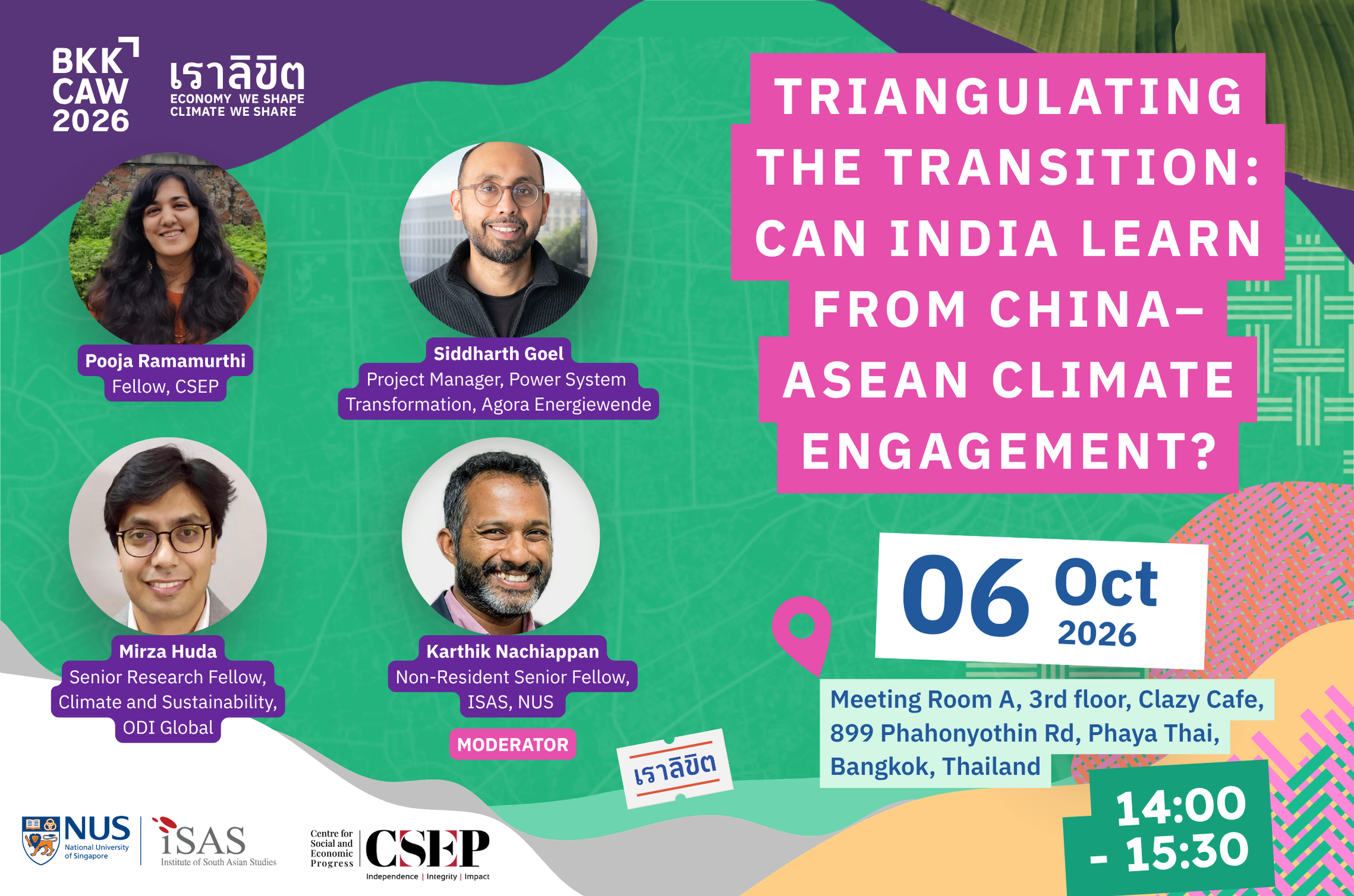
Triangulating the Transition: Can India Learn from China–ASEAN Climate Engagement
This session by the Institute of South Asian Studies(ISAS), National University of Singapore (NUS) and the Centre for Social and Economic Progress(CSEP), New Delhi will examine China's engagement with ASEAN on climate and the energy transition, and consider what India can learn from these experiences while accounting for its own strategic, economic, technological, and institutional context. Objectives •Assess China–ASEAN climate engagement across mitigation and adaptation: Map the channels through which cooperation occurs, including investment, clean-tech supply chains, the ASEAN Power Grid, standards-setting, green finance, policy exchanges, capacity-building, and subnational partnerships, and evaluate their results. •Identify transferable lessons and safeguards for India: Determine which ASEAN experiences with China could support India's energy transition and climate action, while considering guardrails relating to domestic manufacturing, environmental and social standards, technological dependence, and local institutional capacity. •Develop a practical agenda for selective India–China climate cooperation: Identify concrete pathways for technical exchanges, research collaboration, city-level partnerships, private-sector engagement, and institutional coordination between India and China, particularly where ASEAN experience offers tested approaches or reveals implementation risks. The objective is to move towards a practical and selective agenda for India–China climate cooperation, grounded in evidence from China's engagement with ASEAN rather than treating regional cooperation as a one-size-fits-all model. Panellists are Pooja Rramamurthi, Fellow, CSEP, Mirza Sadaqat Huda, Senior Research Fellow, ODI Global, Siddarth Goel, Project Manager, Agora Energiewende, moderated by Karthik Nachiappan, Non Resident Senior Fellow, ISAS, NUS.
06/10/2026 • 14:00
Clazy Cafe
Triangulating the Transition: Can India Learn from China–ASEAN Climate Engagement
This session by the Institute of South Asian Studies(ISAS), National University of Singapore (NUS) and the Centre for Social and Economic Progress(CSEP), New Delhi will examine China's engagement with ASEAN on climate and the energy transition, and consider what India can learn from these experiences while accounting for its own strategic, economic, technological, and institutional context. Objectives •Assess China–ASEAN climate engagement across mitigation and adaptation: Map the channels through which cooperation occurs, including investment, clean-tech supply chains, the ASEAN Power Grid, standards-setting, green finance, policy exchanges, capacity-building, and subnational partnerships, and evaluate their results. •Identify transferable lessons and safeguards for India: Determine which ASEAN experiences with China could support India's energy transition and climate action, while considering guardrails relating to domestic manufacturing, environmental and social standards, technological dependence, and local institutional capacity. •Develop a practical agenda for selective India–China climate cooperation: Identify concrete pathways for technical exchanges, research collaboration, city-level partnerships, private-sector engagement, and institutional coordination between India and China, particularly where ASEAN experience offers tested approaches or reveals implementation risks. The objective is to move towards a practical and selective agenda for India–China climate cooperation, grounded in evidence from China's engagement with ASEAN rather than treating regional cooperation as a one-size-fits-all model. Panellists are Pooja Rramamurthi, Fellow, CSEP, Mirza Sadaqat Huda, Senior Research Fellow, ODI Global, Siddarth Goel, Project Manager, Agora Energiewende, moderated by Karthik Nachiappan, Non Resident Senior Fellow, ISAS, NUS.
06/10/2026 • 14:00
Clazy Cafe
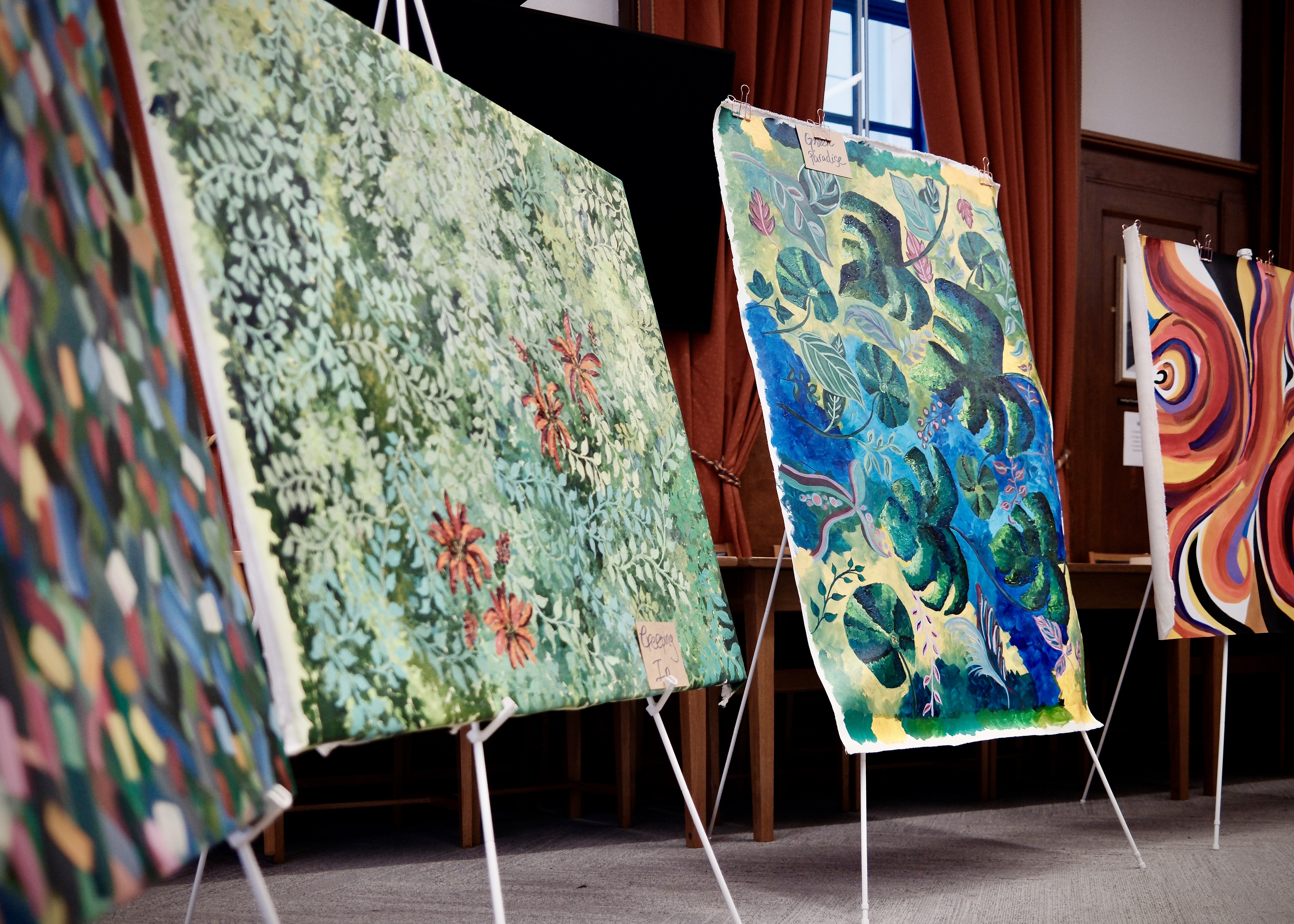
What Will She Inherit? Art x Climate Dialogue
Beyond climate targets and finance: what are we truly leaving behind for the next generation? **6 October 2026 | 1:30–3:30 pm | Lumphini Park, Recreation center - second floor ** **Registration via Luma only | Limited attendance** What Will She Inherit? is an intimate Art × Climate Dialogue bringing together leaders from climate finance, business, philanthropy, policy, academia, and the arts for a conversation about the future we are leaving behind. Using original artworks as a starting point, the salon will explore a simple but difficult question: What will the next generation inherit from the choices we make today? There are no panels or presentations. Instead, a small, carefully curated group will come together for a participatory conversation about climate, responsibility, memory, and inheritance. The Bangkok salon builds on the first What Will She Inherit? gathering held during London Climate Action Week earlier this year. About the Artist The salon is curated by Riya Saxena, a New Delhi–based climate finance specialist and contemporary artist. Her work brings together nearly a decade in climate finance and energy transition with an artistic practice exploring motherhood, memory, nature, and climate inheritance. Attendance is limited to keep the conversation intimate and meaningful.
06/10/2026 •
Lumphini Park
What Will She Inherit? Art x Climate Dialogue
Beyond climate targets and finance: what are we truly leaving behind for the next generation? **6 October 2026 | 1:30–3:30 pm | Lumphini Park, Recreation center - second floor ** **Registration via Luma only | Limited attendance** What Will She Inherit? is an intimate Art × Climate Dialogue bringing together leaders from climate finance, business, philanthropy, policy, academia, and the arts for a conversation about the future we are leaving behind. Using original artworks as a starting point, the salon will explore a simple but difficult question: What will the next generation inherit from the choices we make today? There are no panels or presentations. Instead, a small, carefully curated group will come together for a participatory conversation about climate, responsibility, memory, and inheritance. The Bangkok salon builds on the first What Will She Inherit? gathering held during London Climate Action Week earlier this year. About the Artist The salon is curated by Riya Saxena, a New Delhi–based climate finance specialist and contemporary artist. Her work brings together nearly a decade in climate finance and energy transition with an artistic practice exploring motherhood, memory, nature, and climate inheritance. Attendance is limited to keep the conversation intimate and meaningful.
06/10/2026 •
Lumphini Park
What Will You Inherit? Youth Art x Climate Dialogue
What kind of world do you want to inherit? A special Art × Climate session for young people **6 October 2026 | 10:00–12:00 pm | Lumphini Park- Recreation center - second floor Bangkok Climate Action Week | Limited attendance ** In collaboration with Youthtopia → Register here: https://luma.com/8hfp004f What Will She Inherit? is a participatory Art × Climate session created especially for young people (16- 25 years) to imagine, question, and share the kind of future they want to inherit. Using original artworks and a live collaborative painting as starting points, we’ll explore a simple question: If you could shape the world you inherit, what would you want it to look and feel like? There are no panels or presentations. Instead, participants will paint, reflect, and talk about what matters to them — from nature and cities to climate, community, and the choices being made today. The ideas and voices emerging from this session will feed directly into a senior leadership dialogue later that afternoon, bringing youth perspectives into a conversation with leaders from climate finance, business, philanthropy, policy, academia, and the arts. About the Artist The session is led by Riya Saxena, a New Delhi–based climate finance specialist and contemporary artist. Her work brings together nearly a decade in climate finance and energy transition with an artistic practice exploring motherhood, memory, nature, and climate inheritance. About Youthtopia This session is being held in collaboration with Youthtopia, a global youth empowerment platform that supports young changemakers to learn, connect, and turn their ideas into action. Come with your ideas. No artistic experience needed. Places are limited.
06/10/2026 • 10:00
Lumphini Parlk
What Will You Inherit? Youth Art x Climate Dialogue
What kind of world do you want to inherit? A special Art × Climate session for young people **6 October 2026 | 10:00–12:00 pm | Lumphini Park- Recreation center - second floor Bangkok Climate Action Week | Limited attendance ** In collaboration with Youthtopia → Register here: https://luma.com/8hfp004f What Will She Inherit? is a participatory Art × Climate session created especially for young people (16- 25 years) to imagine, question, and share the kind of future they want to inherit. Using original artworks and a live collaborative painting as starting points, we’ll explore a simple question: If you could shape the world you inherit, what would you want it to look and feel like? There are no panels or presentations. Instead, participants will paint, reflect, and talk about what matters to them — from nature and cities to climate, community, and the choices being made today. The ideas and voices emerging from this session will feed directly into a senior leadership dialogue later that afternoon, bringing youth perspectives into a conversation with leaders from climate finance, business, philanthropy, policy, academia, and the arts. About the Artist The session is led by Riya Saxena, a New Delhi–based climate finance specialist and contemporary artist. Her work brings together nearly a decade in climate finance and energy transition with an artistic practice exploring motherhood, memory, nature, and climate inheritance. About Youthtopia This session is being held in collaboration with Youthtopia, a global youth empowerment platform that supports young changemakers to learn, connect, and turn their ideas into action. Come with your ideas. No artistic experience needed. Places are limited.
06/10/2026 • 10:00
Lumphini Parlk
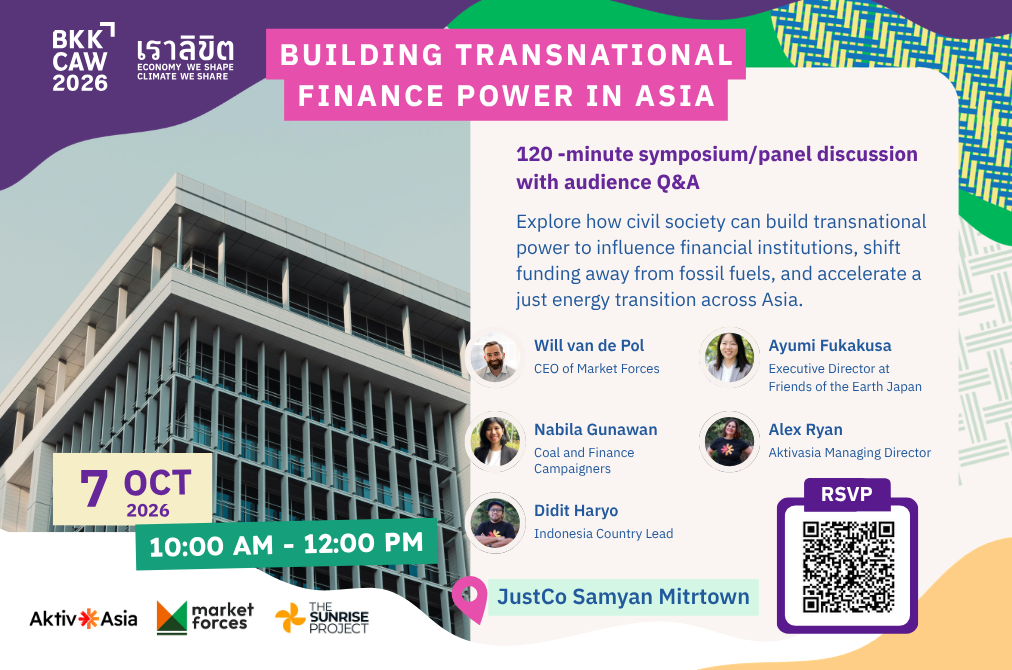
Building Transnational Finance Power in Asia
As Asia accelerates its transition away from fossil fuels, civil society has a critical role to play in influencing the financial institutions that continue to fund coal, oil and gas expansion. This symposium will bring together campaign leaders, researchers and movement organisations to share practical lessons on building transnational campaigns, strengthening regional collaboration and shifting financial flows towards a just energy transition across Asia.
07/10/2026 • 10:00
JustCo – Samyan Mitrtown
Building Transnational Finance Power in Asia
As Asia accelerates its transition away from fossil fuels, civil society has a critical role to play in influencing the financial institutions that continue to fund coal, oil and gas expansion. This symposium will bring together campaign leaders, researchers and movement organisations to share practical lessons on building transnational campaigns, strengthening regional collaboration and shifting financial flows towards a just energy transition across Asia.
07/10/2026 • 10:00
JustCo – Samyan Mitrtown
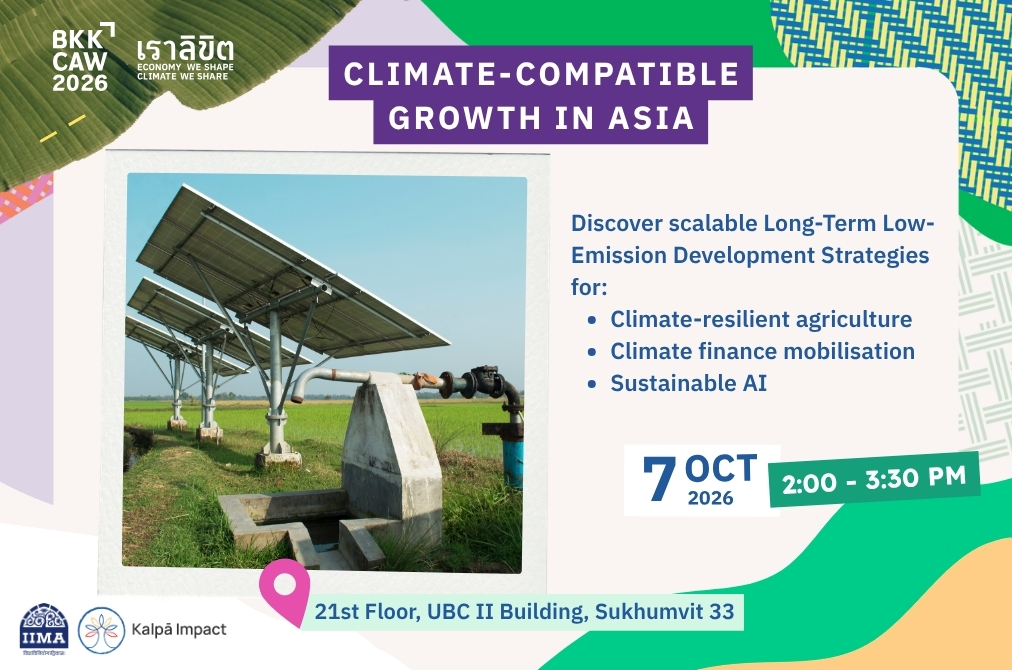
Climate-Compatible Growth in Asia: Agriculture, Climate Finance and AI
Across Asia, countries face a shared imperative: sustaining economic growth while meeting climate commitments and building resilience. This session will explore how Long-term low-carbon development strategies (LT-LEDS) can ensure these priorities reinforce each other. The session will address three critical questions: 1. What is needed to build climate-resilient, low-emission agricultural systems? 2. How can we mobilise finance to accelerate climate action across the Global South? 3. How can AI drive climate action while minimising its environmental footprint? Grounded in field-level insights from the IndiaLEDS Research and Action Platform, the discussion will explore structural choices, trade-offs, and investment frameworks. The IndiaLEDS Research and Action Platform, a joint initiative by Kalpa Impact and India Institute of Management, Ahmedabad, is a collaborative hub that documents operational low-emission development pathways at national and sub-national levels, bringing together policymakers, researchers, and practitioners to support evidence-based climate action. About the organisers Kalpa Impact is a global strategy consulting and programme implementation organisation. Its work spans climate resilience, artificial intelligence, digital public infrastructure, and health innovation. Established in 1961, IIMA is India's premier business school, ranked #21 globally in the 2026 QS World University Rankings for Business & Management Studies and #27 in the FT Global MBA Rankings.
07/10/2026 • 14:00
21st Floor, UBC II Building, Sukhumvit 33
Climate-Compatible Growth in Asia: Agriculture, Climate Finance and AI
Across Asia, countries face a shared imperative: sustaining economic growth while meeting climate commitments and building resilience. This session will explore how Long-term low-carbon development strategies (LT-LEDS) can ensure these priorities reinforce each other. The session will address three critical questions: 1. What is needed to build climate-resilient, low-emission agricultural systems? 2. How can we mobilise finance to accelerate climate action across the Global South? 3. How can AI drive climate action while minimising its environmental footprint? Grounded in field-level insights from the IndiaLEDS Research and Action Platform, the discussion will explore structural choices, trade-offs, and investment frameworks. The IndiaLEDS Research and Action Platform, a joint initiative by Kalpa Impact and India Institute of Management, Ahmedabad, is a collaborative hub that documents operational low-emission development pathways at national and sub-national levels, bringing together policymakers, researchers, and practitioners to support evidence-based climate action. About the organisers Kalpa Impact is a global strategy consulting and programme implementation organisation. Its work spans climate resilience, artificial intelligence, digital public infrastructure, and health innovation. Established in 1961, IIMA is India's premier business school, ranked #21 globally in the 2026 QS World University Rankings for Business & Management Studies and #27 in the FT Global MBA Rankings.
07/10/2026 • 14:00
21st Floor, UBC II Building, Sukhumvit 33
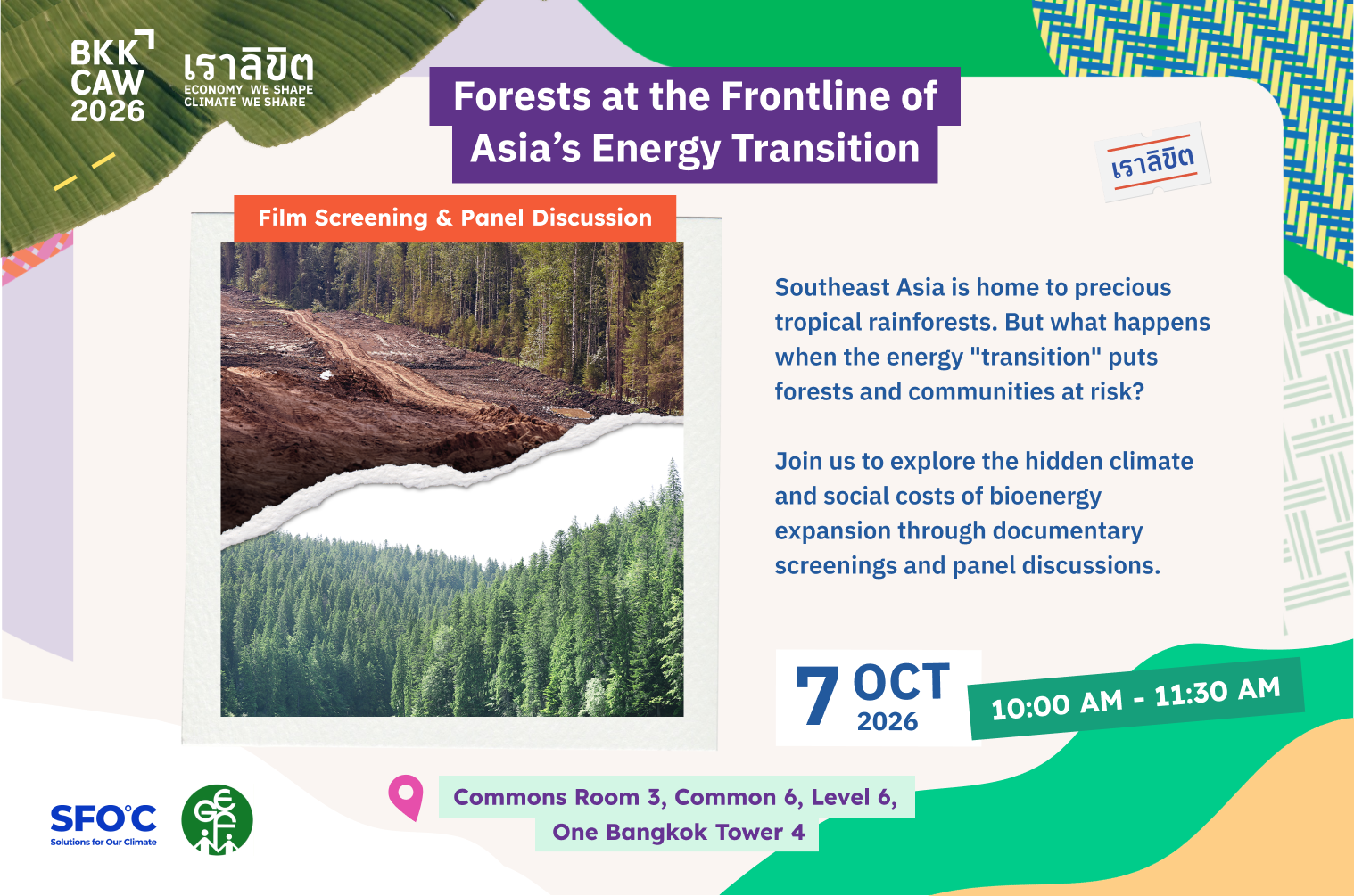
Forests at the Frontline of Asia’s Energy Transition
As decarbonization pressures and energy security concerns grow, what does increasing bioenergy demand mean for Southeast Asia’s forests and the communities that depend on them? Join us for documentary screenings exploring the environmental and social impacts of bioenergy expansion including deforestation, biodiversity loss and threats to local livelihoods, followed by a panel discussion featuring voices from frontline communities, civil society, researchers and regional experts. Exploring the environmental and social impacts of bioenergy expansion, including deforestation, biodiversity loss, and impacts on local livelihoods. This event is open to anyone interested in forests, climate action, renewable energy, and a just energy transition.
07/10/2026 • 10:00
Commons Room 3, Common 6, Level 6, One Bangkok Tower 4
Forests at the Frontline of Asia’s Energy Transition
As decarbonization pressures and energy security concerns grow, what does increasing bioenergy demand mean for Southeast Asia’s forests and the communities that depend on them? Join us for documentary screenings exploring the environmental and social impacts of bioenergy expansion including deforestation, biodiversity loss and threats to local livelihoods, followed by a panel discussion featuring voices from frontline communities, civil society, researchers and regional experts. Exploring the environmental and social impacts of bioenergy expansion, including deforestation, biodiversity loss, and impacts on local livelihoods. This event is open to anyone interested in forests, climate action, renewable energy, and a just energy transition.
07/10/2026 • 10:00
Commons Room 3, Common 6, Level 6, One Bangkok Tower 4
Founders & Funders of Climate Innovation
Calling all founders and funders in climate tech! Join The Radical Fund, Beacon Venture Capital, and Investors for Climate for an evening of connection, ideas, and collaboration during Bangkok Climate Action Week. Our aim is to convene founders who are building in (or curious about) climate tech with investors, corporates, and ecosystem builders so that we can accelerate the green transition across Bangkok and Southeast Asia. Programming: 6:00 – 6:30pm | Registration 6:30 – 6:40pm | Welcome Remarks Opening notes from co-hosts The Radical Fund and Beacon Venture Capital. Attendees are invited to grab light bites and refreshments. 6:40 – 7:10pm | Panel Details coming soon! 7:10 – 8:30pm | Networking Reception Networking with founders, VCs, corporates, and ecosystem builders. This is a private event with limited capacity, please secure your spot by registering. We look forward to seeing you!
07/10/2026 • 18:00
Soho House Bangkok
Founders & Funders of Climate Innovation
Calling all founders and funders in climate tech! Join The Radical Fund, Beacon Venture Capital, and Investors for Climate for an evening of connection, ideas, and collaboration during Bangkok Climate Action Week. Our aim is to convene founders who are building in (or curious about) climate tech with investors, corporates, and ecosystem builders so that we can accelerate the green transition across Bangkok and Southeast Asia. Programming: 6:00 – 6:30pm | Registration 6:30 – 6:40pm | Welcome Remarks Opening notes from co-hosts The Radical Fund and Beacon Venture Capital. Attendees are invited to grab light bites and refreshments. 6:40 – 7:10pm | Panel Details coming soon! 7:10 – 8:30pm | Networking Reception Networking with founders, VCs, corporates, and ecosystem builders. This is a private event with limited capacity, please secure your spot by registering. We look forward to seeing you!
07/10/2026 • 18:00
Soho House Bangkok
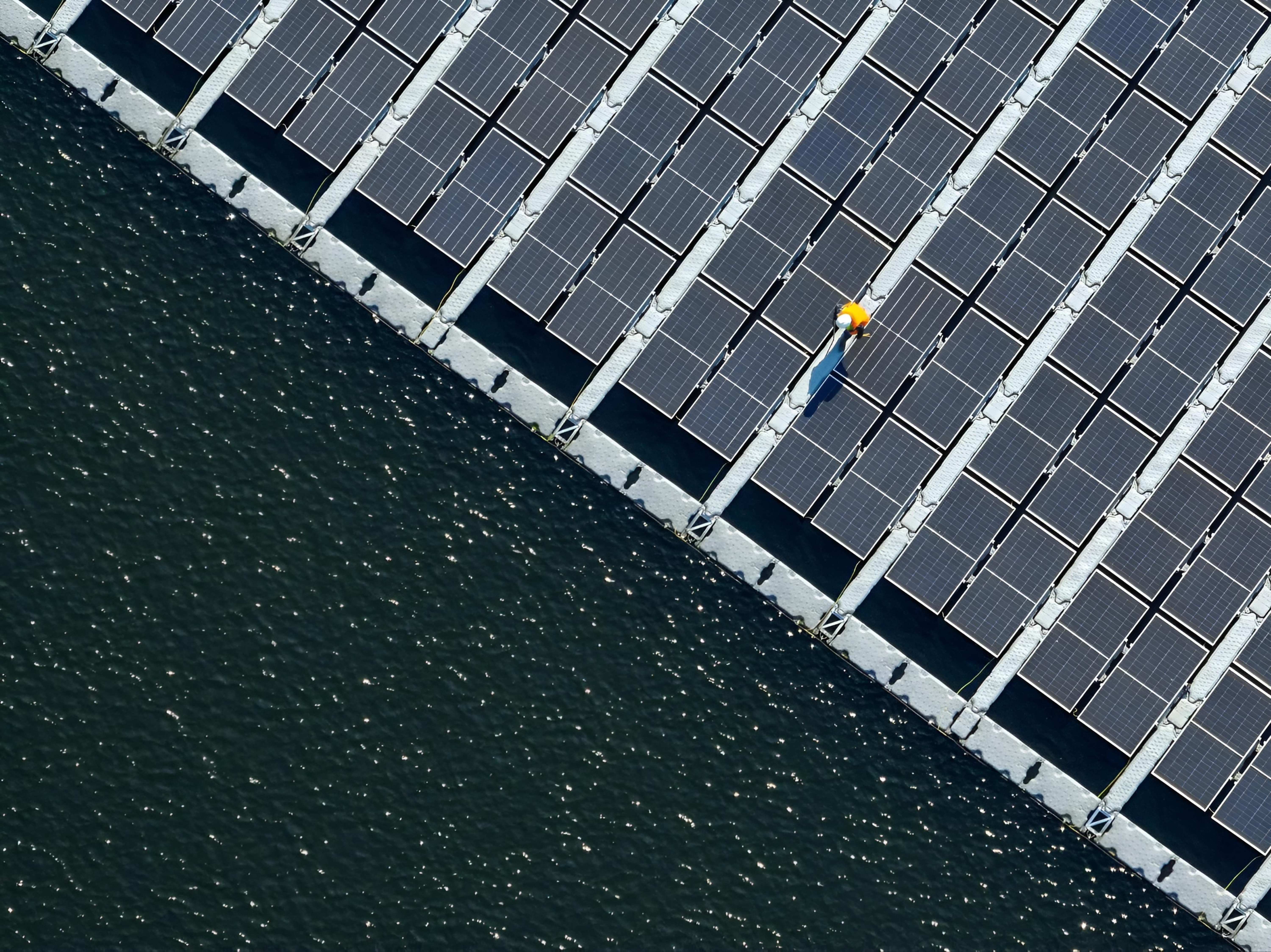
From Commitments to Capital: Mobilizing Climate Finance Through Energy Transition Country Platforms
Emerging economies face a pressing dual challenge: accelerating the transition to low-carbon energy systems while unlocking the up-front investment to achieve it. With early-stage energy transition financing needs far outstripping available public resources, scaling up private capital mobilization has become indispensable. Energy transition country platforms — including Just Energy Transition Partnerships (JETPs), other country-led investment platforms, and blended finance facilities — have emerged as a promising mechanism for aligning public policy, concessional finance, and private capital around national transition priorities. JETPs in South Africa, Indonesia, Vietnam, and Senegal have secured approximately USD 46.5 billion in commitments, demonstrating the potential of coordinated platforms to aggregate finance and policy support behind country-led plans. However, experience to date also highlights significant implementation challenges: slow disbursement, project preparation bottlenecks, limited private capital mobilization, and the need to ensure a just transition that creates jobs and supports affected communities. The central question is no longer whether the transition is achievable. It is how to convert initial commitments into investable projects that mobilize private finance at scale, and deliver a transition that is economically inclusive, socially just, and aligned with national development priorities. This panel convenes energy transition experts to discuss how energy transition platforms can move from commitment to catalytic investment mobilization.
07/10/2026 • 09:00
One Bangkok Tower 4
From Commitments to Capital: Mobilizing Climate Finance Through Energy Transition Country Platforms
Emerging economies face a pressing dual challenge: accelerating the transition to low-carbon energy systems while unlocking the up-front investment to achieve it. With early-stage energy transition financing needs far outstripping available public resources, scaling up private capital mobilization has become indispensable. Energy transition country platforms — including Just Energy Transition Partnerships (JETPs), other country-led investment platforms, and blended finance facilities — have emerged as a promising mechanism for aligning public policy, concessional finance, and private capital around national transition priorities. JETPs in South Africa, Indonesia, Vietnam, and Senegal have secured approximately USD 46.5 billion in commitments, demonstrating the potential of coordinated platforms to aggregate finance and policy support behind country-led plans. However, experience to date also highlights significant implementation challenges: slow disbursement, project preparation bottlenecks, limited private capital mobilization, and the need to ensure a just transition that creates jobs and supports affected communities. The central question is no longer whether the transition is achievable. It is how to convert initial commitments into investable projects that mobilize private finance at scale, and deliver a transition that is economically inclusive, socially just, and aligned with national development priorities. This panel convenes energy transition experts to discuss how energy transition platforms can move from commitment to catalytic investment mobilization.
07/10/2026 • 09:00
One Bangkok Tower 4

The Exhibition "Un Monde Sans Fin" (World Without End)
Adapted from the bestselling graphic novel Le Monde sans fin by Jean-Marc Jancovici and Christophe Blain, this exhibition explores the fascinating relationship between energy, climate, and the history of humanity. Through humour, imagination, and accessible storytelling, the exhibition takes visitors on a journey through the rise of fossil fuels, humanity’s impact on the environment, and the challenges of climate change. From low-carbon energy and food to transportation and urban planning, World Without End invites us to reflect on the choices ahead—and the actions we can take towards a more sustainable future.
14/09/2026 • 10:00
Alliance Française de Bangkok
The Exhibition "Un Monde Sans Fin" (World Without End)
Adapted from the bestselling graphic novel Le Monde sans fin by Jean-Marc Jancovici and Christophe Blain, this exhibition explores the fascinating relationship between energy, climate, and the history of humanity. Through humour, imagination, and accessible storytelling, the exhibition takes visitors on a journey through the rise of fossil fuels, humanity’s impact on the environment, and the challenges of climate change. From low-carbon energy and food to transportation and urban planning, World Without End invites us to reflect on the choices ahead—and the actions we can take towards a more sustainable future.
14/09/2026 • 10:00
Alliance Française de Bangkok
EmPower bootcamp: AI for gender-responsive climate action
03/10/2026 • 13:00
Nextopia
EmPower bootcamp: AI for gender-responsive climate action
03/10/2026 • 13:00
Nextopia
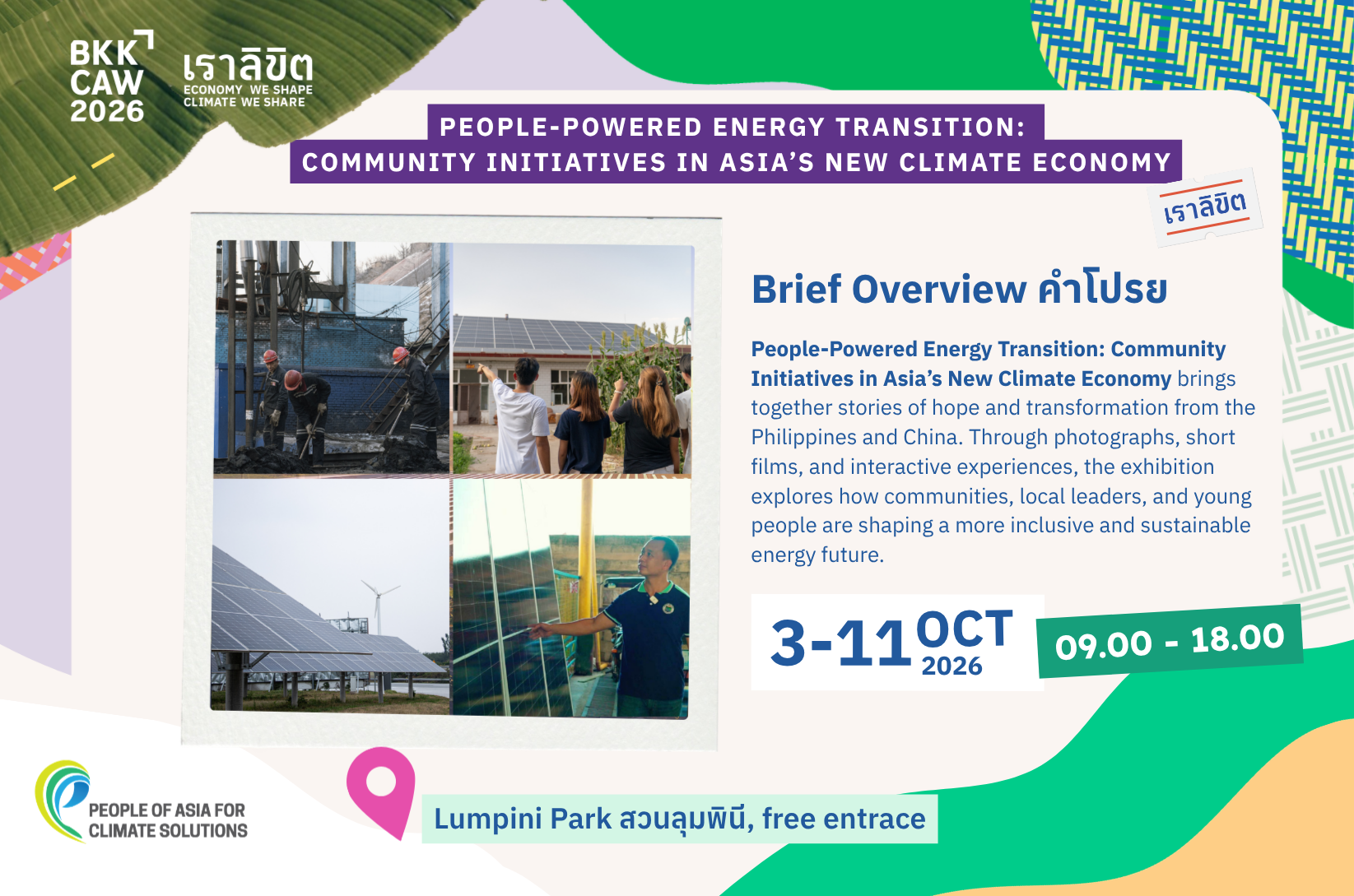
People-Powered Energy Transition: Community Initiatives in Asia’s New Climate Economy
People-Powered Energy Transition: Community Initiatives in Asia’s New Climate Economy is a visual storytelling exhibition that brings together stories from the Philippines and China that demonstrate how people are shaping a new climate economy through courage, resilience, and collective action. While each story unfolds in a different context, they are united by the belief that meaningful transformation begins with people. Bringing together stories from the Philippines and China, the exhibition shows how communities, workers, local leaders, and young people are navigating change and shaping new possibilities in the climate economy. In Barangay Bicos, Nueva Ecija, Philippines, local leadership and community action demonstrate how communities can take steps toward more affordable and accessible renewable energy, while also confronting the financial and institutional challenges that come with making the transition. In Shanxi, communities are navigating the complex transition beyond coal, revealing both the challenges and opportunities of building new livelihoods and a more sustainable future. Through the Future Renewable Energy Engineer (FREE) Program, young Filipinos are preparing to become the next generation of renewable energy leaders, showing that investing in people is essential to sustaining the transition for decades to come. Through photographs, short films, personal stories, and interactive experiences, the exhibition brings these journeys to life. The photo storytelling installations offer glimpses into communities and people experiencing transition firsthand, while short film screenings allow visitors to hear directly from those at the heart of these stories. Together, the stories reveal that the energy transition is a process shaped by people's choices, aspirations, resilience, and ability to adapt. These are ultimately stories of hope and transformation. They show what becomes possible when communities are empowered to act, when people are given opportunities to build new livelihoods and skills, and when investments in today's young people are sustained for the future. The exhibition invites visitors to reflect on their own role in shaping a new climate economy and to see that a just and sustainable future is not built by technology alone, but by the people who imagine it, shape it, and make it possible.
03/10/2026 • 09:00
Lumpini Hall
People-Powered Energy Transition: Community Initiatives in Asia’s New Climate Economy
People-Powered Energy Transition: Community Initiatives in Asia’s New Climate Economy is a visual storytelling exhibition that brings together stories from the Philippines and China that demonstrate how people are shaping a new climate economy through courage, resilience, and collective action. While each story unfolds in a different context, they are united by the belief that meaningful transformation begins with people. Bringing together stories from the Philippines and China, the exhibition shows how communities, workers, local leaders, and young people are navigating change and shaping new possibilities in the climate economy. In Barangay Bicos, Nueva Ecija, Philippines, local leadership and community action demonstrate how communities can take steps toward more affordable and accessible renewable energy, while also confronting the financial and institutional challenges that come with making the transition. In Shanxi, communities are navigating the complex transition beyond coal, revealing both the challenges and opportunities of building new livelihoods and a more sustainable future. Through the Future Renewable Energy Engineer (FREE) Program, young Filipinos are preparing to become the next generation of renewable energy leaders, showing that investing in people is essential to sustaining the transition for decades to come. Through photographs, short films, personal stories, and interactive experiences, the exhibition brings these journeys to life. The photo storytelling installations offer glimpses into communities and people experiencing transition firsthand, while short film screenings allow visitors to hear directly from those at the heart of these stories. Together, the stories reveal that the energy transition is a process shaped by people's choices, aspirations, resilience, and ability to adapt. These are ultimately stories of hope and transformation. They show what becomes possible when communities are empowered to act, when people are given opportunities to build new livelihoods and skills, and when investments in today's young people are sustained for the future. The exhibition invites visitors to reflect on their own role in shaping a new climate economy and to see that a just and sustainable future is not built by technology alone, but by the people who imagine it, shape it, and make it possible.
03/10/2026 • 09:00
Lumpini Hall
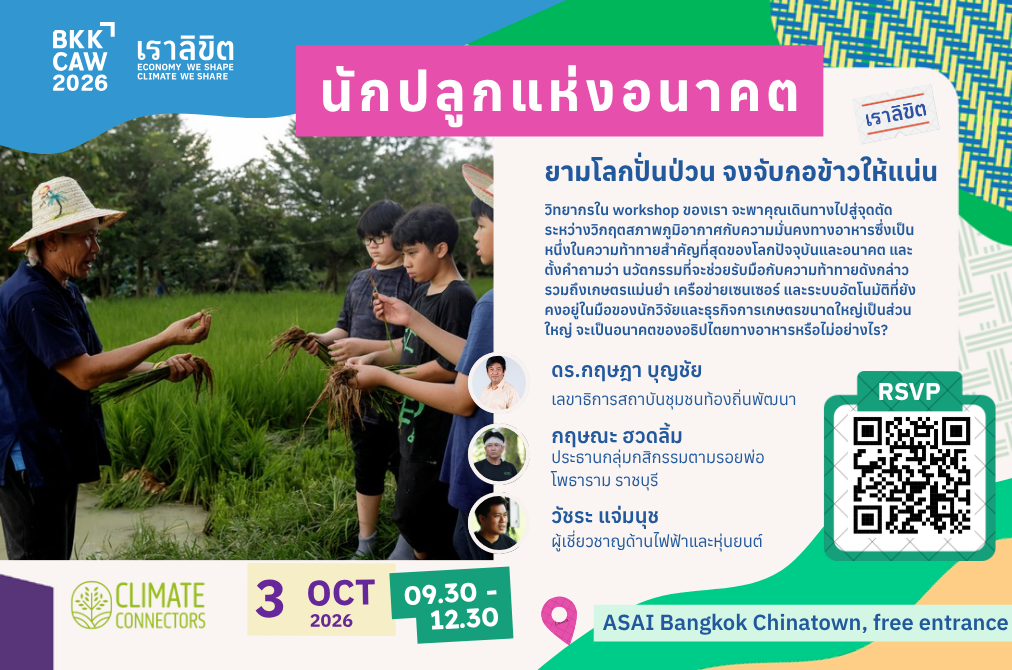
Smart Transfarmer
This hands-on workshop invites everyone to explore how technology, traditional farming knowledge, and creativity can come together to shape the future of food in a changing climate. Through a learning journey, participants move from the field to the digital world and back again: learning alongside experienced farmers, building an open-source FarmBot, coding automated planting and watering systems, experimenting with AI-powered plant identification, and finally harvesting and sharing what they have grown. Presented as a live, participatory experience at Bangkok Climate Action Week, the workshop inspires people how we can transform from technology end-users into makers and problem-solvers. By connecting digital skills with food, farming, and real-world climate challenges, it demonstrates how accessible technology can become a tool for climate action, community resilience, and a new generation of agricultural innovation.
03/10/2026 • 09:30
ASAI Bangkok Chinatown
Smart Transfarmer
This hands-on workshop invites everyone to explore how technology, traditional farming knowledge, and creativity can come together to shape the future of food in a changing climate. Through a learning journey, participants move from the field to the digital world and back again: learning alongside experienced farmers, building an open-source FarmBot, coding automated planting and watering systems, experimenting with AI-powered plant identification, and finally harvesting and sharing what they have grown. Presented as a live, participatory experience at Bangkok Climate Action Week, the workshop inspires people how we can transform from technology end-users into makers and problem-solvers. By connecting digital skills with food, farming, and real-world climate challenges, it demonstrates how accessible technology can become a tool for climate action, community resilience, and a new generation of agricultural innovation.
03/10/2026 • 09:30
ASAI Bangkok Chinatown
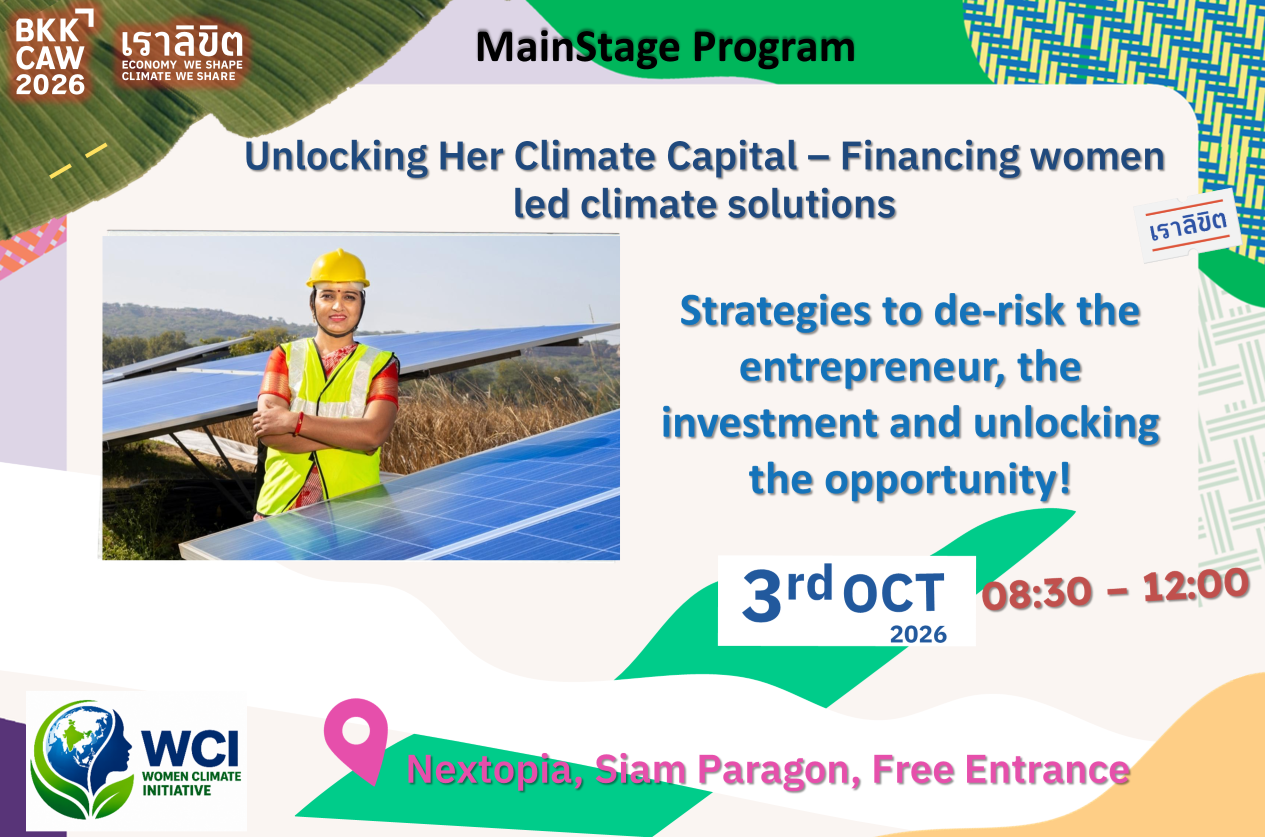
Unlocking Her Climate Capital - Financing women-led climate solutions
What if the women building climate solutions weren’t seen as risky—but as the investment opportunity? Across South and Southeast Asia, women are building businesses that strengthen communities and respond to climate challenges. Yet too many struggle to access the finance, markets, networks, and policies needed to scale. This session brings together entrepreneurs, investors, policymakers and ecosystem leaders to ask a critical question: How do we de-risk the entrepreneur, de-risk the investment, and unlock the opportunity? Expect bold perspectives, practical solutions, and young women’s voices on the future of green jobs and climate entrepreneurship. Together, we will explore how catalytic capital, blended finance, markets and smarter policy can turn women-led climate solutions into scalable engines of inclusive climate action.
03/10/2026 • 08:30
Nextopia - Siam Paragon
Unlocking Her Climate Capital - Financing women-led climate solutions
What if the women building climate solutions weren’t seen as risky—but as the investment opportunity? Across South and Southeast Asia, women are building businesses that strengthen communities and respond to climate challenges. Yet too many struggle to access the finance, markets, networks, and policies needed to scale. This session brings together entrepreneurs, investors, policymakers and ecosystem leaders to ask a critical question: How do we de-risk the entrepreneur, de-risk the investment, and unlock the opportunity? Expect bold perspectives, practical solutions, and young women’s voices on the future of green jobs and climate entrepreneurship. Together, we will explore how catalytic capital, blended finance, markets and smarter policy can turn women-led climate solutions into scalable engines of inclusive climate action.
03/10/2026 • 08:30
Nextopia - Siam Paragon
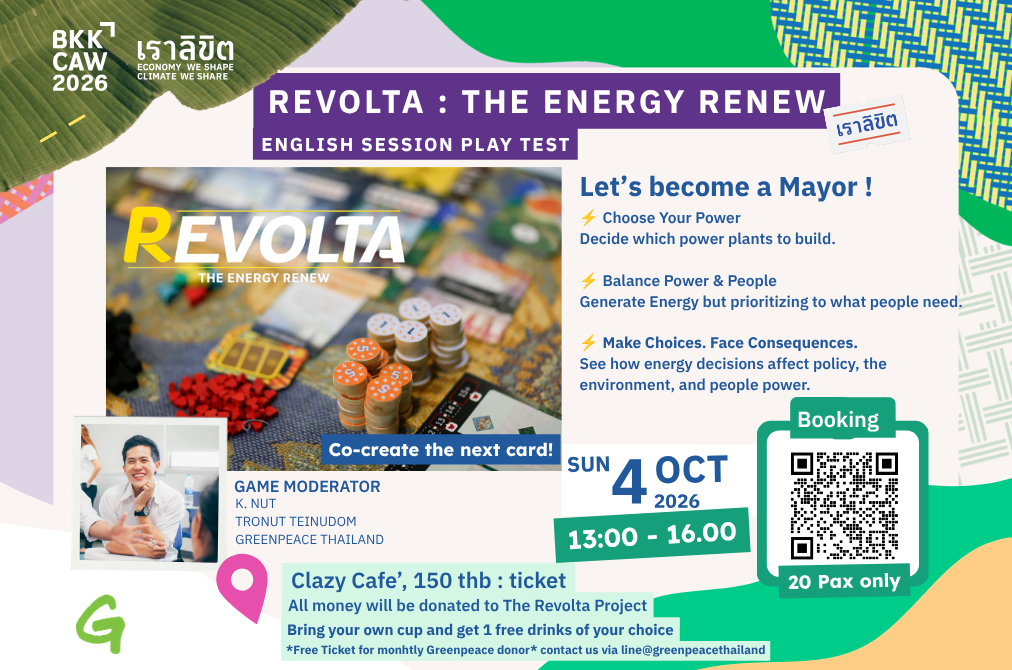
"Revolta : The Energy Renew" Let's become a Mayor!
⚡Choose Your Power Decide which power plants to build and manage. ⚡Balance Power & People Work with energy companies while prioritising to what your people need. ⚡Make Choices. Face Consequences. See how energy decisions affect policy, the environment, and people power. 🎲READY TO LEAD? 🧋Grab a seat, your favorite afternoon drinks and test your strategy and policy skills in our Climate & Energy boardgame workshop "Revolta : The Energy Renew" Special ! chance to co-create the next card designs from your Idea. Venue : Clazy Cafe 2nd floor ( 5 Mins walk from BTS Sanam Pao Exit 1 ) Date & Time : Sunday 4 October 1 PM - 4 PM Ticket : 150 per person ( Bring your own cup and get Free 1 drinks of your choice ) FREE TICKET for Monthly Greenpeace Supporter contact us via Line @greenpeacethailand Preferably 16+ years old Primary Contact: Nut (0642429359) – Lead Coordinator & Game Facilitator Line @greenpeacethailand Thank you and see you there ! Visit our 3 min review : https://www.youtube.com/shorts/llDFVVsCZmw
04/10/2026 • 13:00
Clazy Cafe'
"Revolta : The Energy Renew" Let's become a Mayor!
⚡Choose Your Power Decide which power plants to build and manage. ⚡Balance Power & People Work with energy companies while prioritising to what your people need. ⚡Make Choices. Face Consequences. See how energy decisions affect policy, the environment, and people power. 🎲READY TO LEAD? 🧋Grab a seat, your favorite afternoon drinks and test your strategy and policy skills in our Climate & Energy boardgame workshop "Revolta : The Energy Renew" Special ! chance to co-create the next card designs from your Idea. Venue : Clazy Cafe 2nd floor ( 5 Mins walk from BTS Sanam Pao Exit 1 ) Date & Time : Sunday 4 October 1 PM - 4 PM Ticket : 150 per person ( Bring your own cup and get Free 1 drinks of your choice ) FREE TICKET for Monthly Greenpeace Supporter contact us via Line @greenpeacethailand Preferably 16+ years old Primary Contact: Nut (0642429359) – Lead Coordinator & Game Facilitator Line @greenpeacethailand Thank you and see you there ! Visit our 3 min review : https://www.youtube.com/shorts/llDFVVsCZmw
04/10/2026 • 13:00
Clazy Cafe'
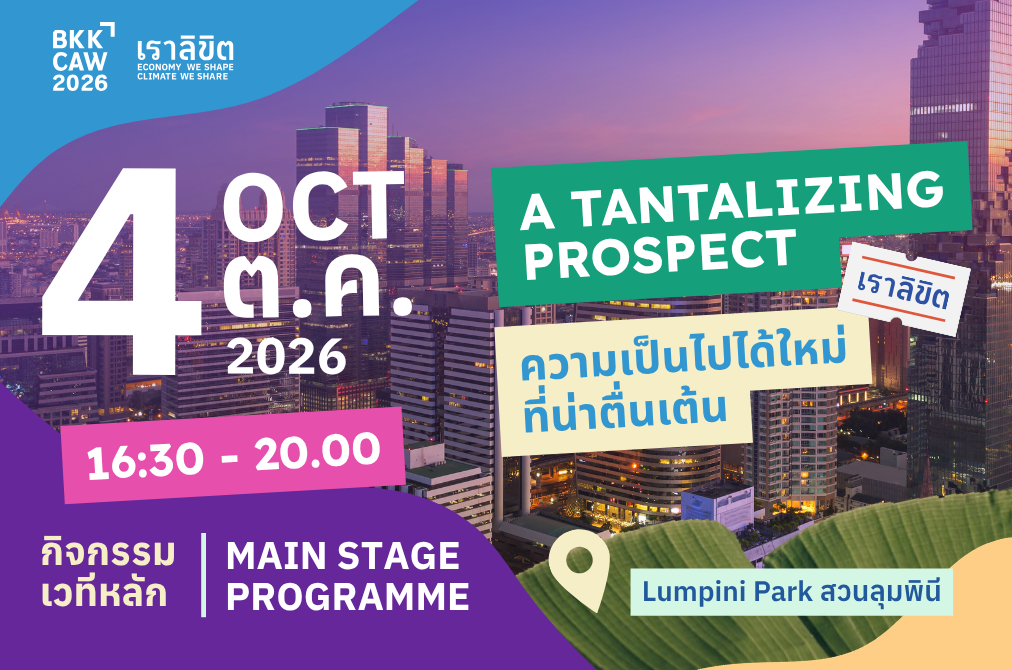
MAIN STAGE | Day 1 | A Tantalizing Prospect
This session explores the promise and tantalizing possibility of new approaches to economics that put people and planet first. It considers how prevailing economic systems fail us and what ‘better’ looks like. It invites the public to ponder: - What if investing in people & nature is the biggest economic opportunity of our time? - What if our economies nurtured rather than exploited people and nature? - What if economics were about nurturing abundance and wellbeing rather than managing scarcity? - How would we rethink value, wealth, metrics of success? Each evening on the main stage, we feature the following: 🎭 Art & Culture Performance (15 min) A showcase celebrating Thailand's Climate Story — 7 Regions, 1 Action. Embracing local wisdom and modern creativity. 📋 BKKCAW recap of the day (15 min) Key highlights, moments and takeaways from today's BKKCAW sessions across the city. 💬 Q&A (10 min) Your questions answered by today's speakers and programme team. 🌀 Theme Wrap-Up (10 min) Reflecting on today's panel discussions and a preview of what's coming tomorrow. 🎵 Climate Concert (1 Hour) Music, art and community energy to close the evening, where sound and culture meet climate action.
04/10/2026 • 16:30
Lumphini Park
MAIN STAGE | Day 1 | A Tantalizing Prospect
This session explores the promise and tantalizing possibility of new approaches to economics that put people and planet first. It considers how prevailing economic systems fail us and what ‘better’ looks like. It invites the public to ponder: - What if investing in people & nature is the biggest economic opportunity of our time? - What if our economies nurtured rather than exploited people and nature? - What if economics were about nurturing abundance and wellbeing rather than managing scarcity? - How would we rethink value, wealth, metrics of success? Each evening on the main stage, we feature the following: 🎭 Art & Culture Performance (15 min) A showcase celebrating Thailand's Climate Story — 7 Regions, 1 Action. Embracing local wisdom and modern creativity. 📋 BKKCAW recap of the day (15 min) Key highlights, moments and takeaways from today's BKKCAW sessions across the city. 💬 Q&A (10 min) Your questions answered by today's speakers and programme team. 🌀 Theme Wrap-Up (10 min) Reflecting on today's panel discussions and a preview of what's coming tomorrow. 🎵 Climate Concert (1 Hour) Music, art and community energy to close the evening, where sound and culture meet climate action.
04/10/2026 • 16:30
Lumphini Park
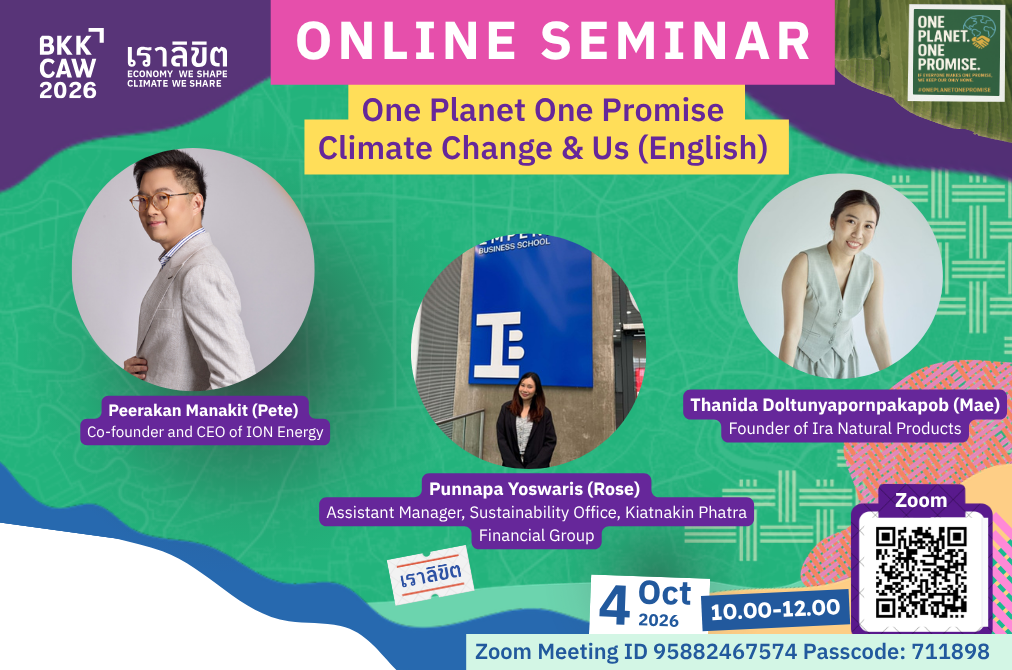
One Planet One Promise
“One Planet, One Promise” under Bangkok Climate Action Change 2026. The objectives of this campaign are telling stories about environmental issues through campaigns that take action for our planet together with the education which is crucial in raising awareness in Thai society. This will lead to transformative change and be a key driving force in reducing the burden on the environment and creating a sustainable future.
04/10/2026 • 10:00
Zoom
One Planet One Promise
“One Planet, One Promise” under Bangkok Climate Action Change 2026. The objectives of this campaign are telling stories about environmental issues through campaigns that take action for our planet together with the education which is crucial in raising awareness in Thai society. This will lead to transformative change and be a key driving force in reducing the burden on the environment and creating a sustainable future.
04/10/2026 • 10:00
Zoom
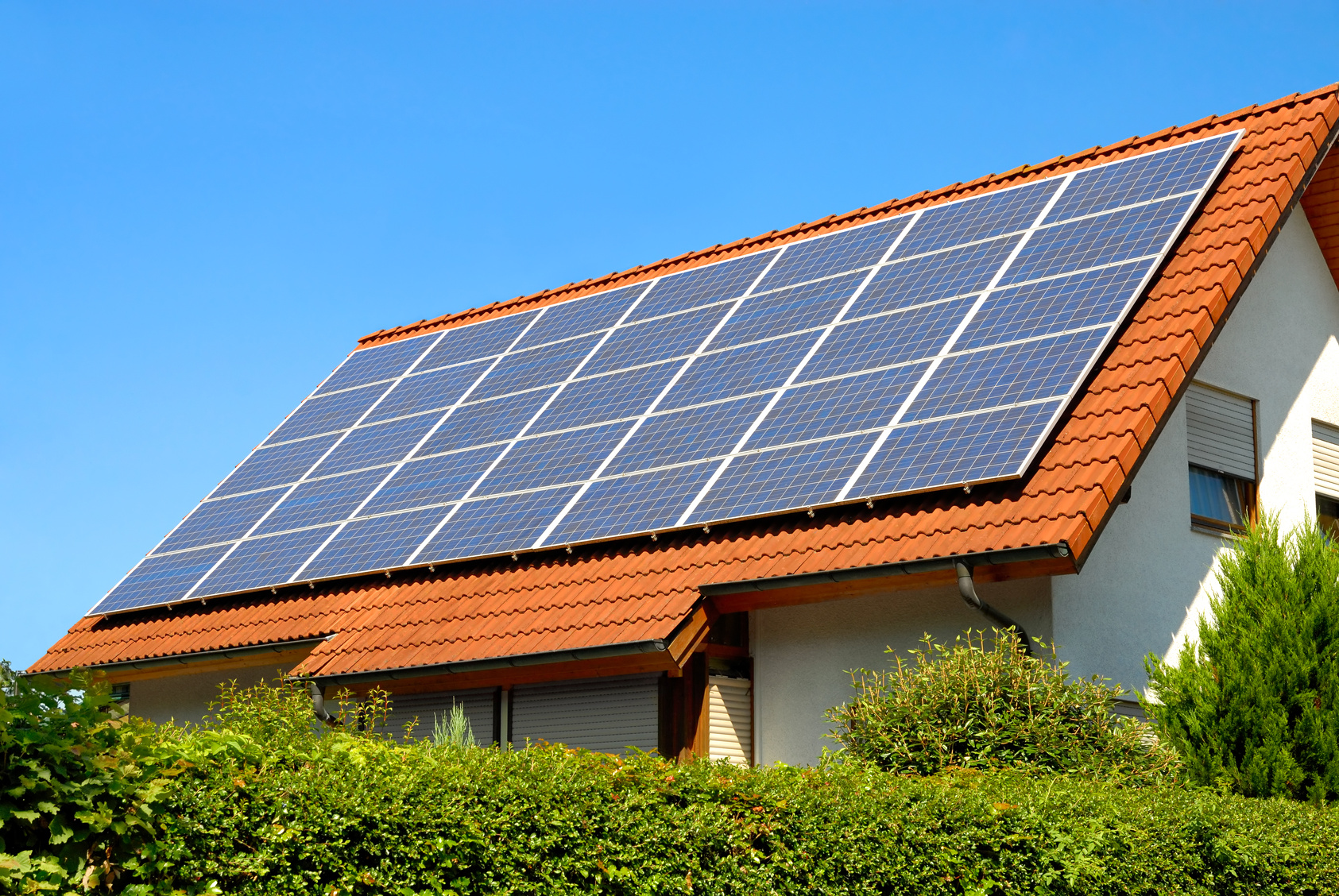
Advancing Distributed Energy Resource (DER) Integration in Thailand: Policy Perspectives and International Experience
Thailand’s power system is evolving as rooftop solar and electric vehicles begin to shape electricity flows more visibly across the grid. As these distributed energy resources (DER) and others continue to expand, policymakers, regulators, and utilities are increasingly considering how planning, governance, and institutional coordination can adapt to support their effective integration. To help advance this conversation, the Clean, Affordable and Secure Energy for Southeast Asia (CASE) project will convene a policy dialogue to present key findings from its forthcoming policy brief, drawing on recent stakeholder consultations and analysis of Thailand’s emerging DER challenges and opportunities to help inform policy action. The event will bring together Thai energy sector institutions and international experts to explore practical approaches for strengthening DER planning, governance, and coordination. Participants will hear perspectives from Germany, Australia, and Pakistan, join a moderated panel discussion on lessons relevant to Thailand, and engage in a facilitated exchange aimed at surfacing upcoming priorities for Thai stakeholders. Designed as a solutions‑focused dialogue, the session aims to support shared understanding and informed discussion on how Thailand can advance effective DER integration in its evolving power system.
05/10/2026 • 09:00
VIE Hotel Bangkok MGallery Collection
Advancing Distributed Energy Resource (DER) Integration in Thailand: Policy Perspectives and International Experience
Thailand’s power system is evolving as rooftop solar and electric vehicles begin to shape electricity flows more visibly across the grid. As these distributed energy resources (DER) and others continue to expand, policymakers, regulators, and utilities are increasingly considering how planning, governance, and institutional coordination can adapt to support their effective integration. To help advance this conversation, the Clean, Affordable and Secure Energy for Southeast Asia (CASE) project will convene a policy dialogue to present key findings from its forthcoming policy brief, drawing on recent stakeholder consultations and analysis of Thailand’s emerging DER challenges and opportunities to help inform policy action. The event will bring together Thai energy sector institutions and international experts to explore practical approaches for strengthening DER planning, governance, and coordination. Participants will hear perspectives from Germany, Australia, and Pakistan, join a moderated panel discussion on lessons relevant to Thailand, and engage in a facilitated exchange aimed at surfacing upcoming priorities for Thai stakeholders. Designed as a solutions‑focused dialogue, the session aims to support shared understanding and informed discussion on how Thailand can advance effective DER integration in its evolving power system.
05/10/2026 • 09:00
VIE Hotel Bangkok MGallery Collection
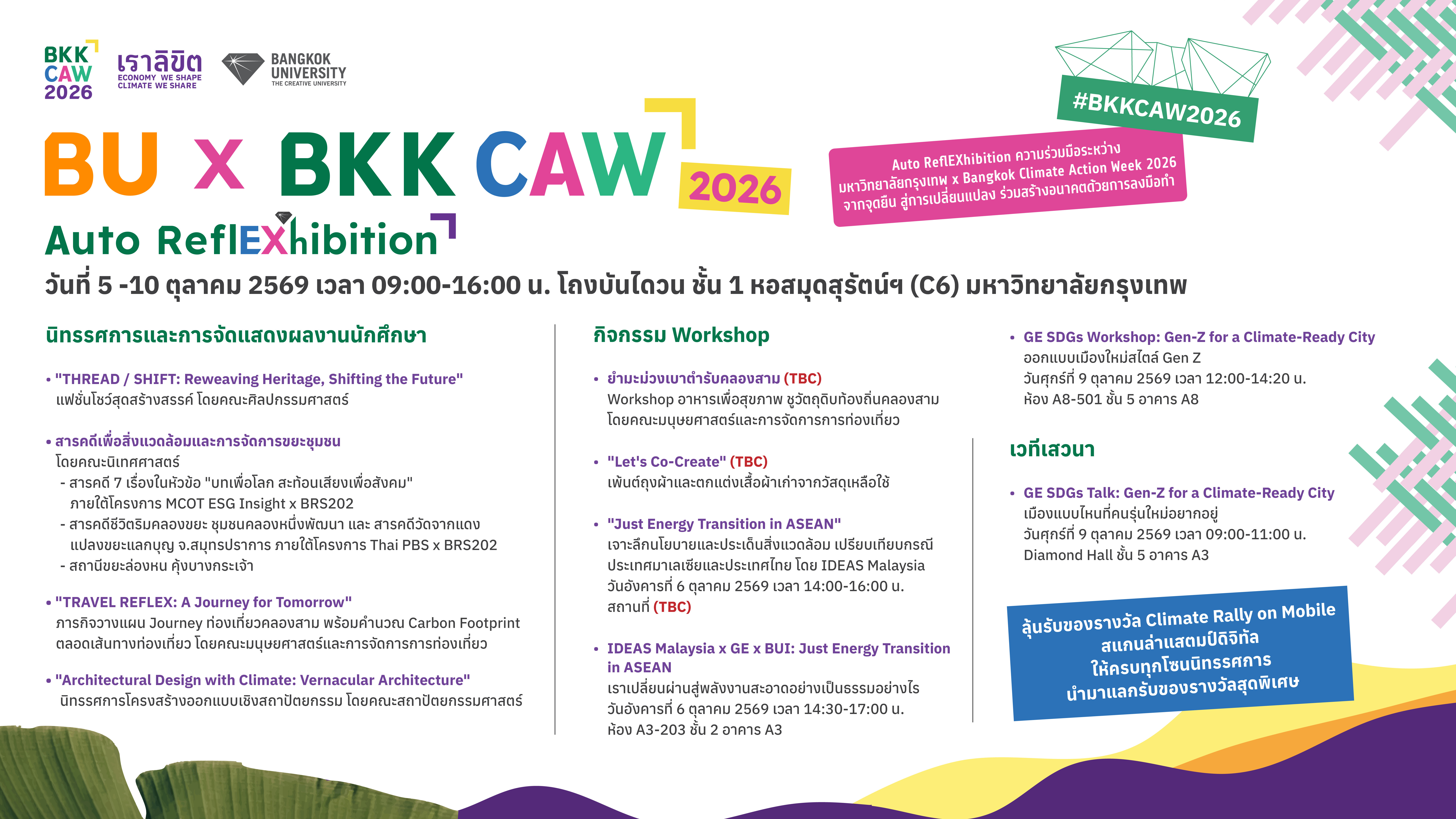
BU x BKKCAW 2026 : Auto ReflEXhibition
Here's the English translation: BU x BKK CAW 2026 AUTO REFL[EX]HIBITION Date: October 5–10, 2026, 09:00–16:00 Spiral Staircase Hall, 1st Floor, Surat Library (C6), Bangkok University Exhibition and Student Showcase "THREAD / SHIFT: Reweaving Heritage, Shifting the Future" A creative fashion show by the Faculty of Fine and Applied Arts Documentaries on the environment and community waste management, by the Faculty of Communication Arts - 7 documentaries under the theme "Scripts for the World, Voices for Society," part of the MCOT ESG Insight x BRS202 project - Documentary on life along the canal of waste, Khlong Nueng Pattana community, and a documentary on Wat Chak Daeng, "trading waste for merit," Samut Prakan Province, under the Thai PBS x BRS202 project - The Invisible Waste Station, Bang Kachao Peninsula "TRAVEL REFLEX: A Journey for Tomorrow" A mission to plan a travel journey along Khlong Sam, including calculating the carbon footprint along the route, by the Faculty of Humanities and Tourism Management "Architectural Design with Climate: Vernacular Architecture" An exhibition of architectural design structures, by the Faculty of Architecture Workshop Activities Khlong Sam-style Light Mango Salad (TBC) A healthy food workshop highlighting local Khlong Sam ingredients, by the Faculty of Humanities and Tourism Management "Let's Co-Create" (TBC) Painting tote bags and decorating old clothes using leftover materials "Just Energy Transition in ASEAN" An in-depth look at environmental policy issues, comparing the cases of Malaysia and Thailand, by IDEAS Malaysia Tuesday, October 6, 2026, 14:00–16:00, Venue TBC IDEAS Malaysia x GE x BUI: Just Energy Transition in ASEAN How can we achieve a fair transition to clean energy? Tuesday, October 6, 2026, 14:30–17:00, Room A3-203, 2nd Floor, Building A3 GE SDGs Workshop: Gen-Z for a Climate-Ready City Designing a new city, Gen Z style Friday, October 9, 2026, 12:00–14:20, Room A8-501, 5th Floor, Building A8 Panel Discussion GE SDGs Talk: Gen-Z for a Climate-Ready City What kind of city does the younger generation want to live in? Friday, October 9, 2026, 09:00–11:00, Diamond Hall, 5th Floor, Building A3 Win Prizes with the Climate Rally on Mobile Scan to collect digital stamps from every exhibition zone and redeem them for special prizes.
05/10/2026 • 09:00
Bangkok University - C6 Building 1st Floor
BU x BKKCAW 2026 : Auto ReflEXhibition
Here's the English translation: BU x BKK CAW 2026 AUTO REFL[EX]HIBITION Date: October 5–10, 2026, 09:00–16:00 Spiral Staircase Hall, 1st Floor, Surat Library (C6), Bangkok University Exhibition and Student Showcase "THREAD / SHIFT: Reweaving Heritage, Shifting the Future" A creative fashion show by the Faculty of Fine and Applied Arts Documentaries on the environment and community waste management, by the Faculty of Communication Arts - 7 documentaries under the theme "Scripts for the World, Voices for Society," part of the MCOT ESG Insight x BRS202 project - Documentary on life along the canal of waste, Khlong Nueng Pattana community, and a documentary on Wat Chak Daeng, "trading waste for merit," Samut Prakan Province, under the Thai PBS x BRS202 project - The Invisible Waste Station, Bang Kachao Peninsula "TRAVEL REFLEX: A Journey for Tomorrow" A mission to plan a travel journey along Khlong Sam, including calculating the carbon footprint along the route, by the Faculty of Humanities and Tourism Management "Architectural Design with Climate: Vernacular Architecture" An exhibition of architectural design structures, by the Faculty of Architecture Workshop Activities Khlong Sam-style Light Mango Salad (TBC) A healthy food workshop highlighting local Khlong Sam ingredients, by the Faculty of Humanities and Tourism Management "Let's Co-Create" (TBC) Painting tote bags and decorating old clothes using leftover materials "Just Energy Transition in ASEAN" An in-depth look at environmental policy issues, comparing the cases of Malaysia and Thailand, by IDEAS Malaysia Tuesday, October 6, 2026, 14:00–16:00, Venue TBC IDEAS Malaysia x GE x BUI: Just Energy Transition in ASEAN How can we achieve a fair transition to clean energy? Tuesday, October 6, 2026, 14:30–17:00, Room A3-203, 2nd Floor, Building A3 GE SDGs Workshop: Gen-Z for a Climate-Ready City Designing a new city, Gen Z style Friday, October 9, 2026, 12:00–14:20, Room A8-501, 5th Floor, Building A8 Panel Discussion GE SDGs Talk: Gen-Z for a Climate-Ready City What kind of city does the younger generation want to live in? Friday, October 9, 2026, 09:00–11:00, Diamond Hall, 5th Floor, Building A3 Win Prizes with the Climate Rally on Mobile Scan to collect digital stamps from every exhibition zone and redeem them for special prizes.
05/10/2026 • 09:00
Bangkok University - C6 Building 1st Floor
Building the Backbone of ASEAN’s Energy Transition: Grid Readiness, Investment, and Regional Integration
Southeast Asia stands at a defining inflection point in its energy transition. Under the ASEAN Plan of Action for Energy Cooperation (APAEC), the region has committed to sourcing 40% of total primary energy supply and 45% of installed power capacity from renewables by 2030. Yet despite these ambitious targets, the gap between policy ambition and implementation is widening. Initially designed for centralized fossil-fuel-based generation, power grids across the region are struggling to adapt to the scale, variability, and geographic spread of renewable energy sources. The Philippines faces a mismatch between offshore wind potential and available transmission capacity. Malaysia's Single Buyer model and cross-subsidy structure are slowing the pace of its transition. Thailand's electricity sector contends with regulatory bottlenecks and grid inflexibility that limit renewable energy distribution. Vietnam's transmission infrastructure is lagging behind its rapid solar and wind deployment. Indonesia's grid expansion, meanwhile, is held back by a financing shortfall — the result of state utility PLN's overleveraged balance sheet and constitutional rulings that bar private-sector participation. At the same time, the ASEAN Power Grid (APG) — conceived in 1997 as a long-term strategy to interconnect the region's power systems, enable cross-border electricity trade, and strengthen energy security — has yet to scale to meet ASEAN's growing energy needs. The Laos–Thailand–Malaysia–Singapore (LTMS) Power Integration Project has demonstrated the viability of multilateral trade, but scaling it will require harmonized grid codes, coordinated dispatch, transparent transmission charges, formal dispute-settlement frameworks, and mechanisms to mobilize the private capital needed for cross-border infrastructure. This panel convenes energy transition experts from across the region to discuss how ASEAN can navigate a patchwork of legal systems, varying levels of market maturity, and divergent political priorities to build a truly integrated, functioning grid.
05/10/2026 • 09:00
One Bangkok Tower 4
Building the Backbone of ASEAN’s Energy Transition: Grid Readiness, Investment, and Regional Integration
Southeast Asia stands at a defining inflection point in its energy transition. Under the ASEAN Plan of Action for Energy Cooperation (APAEC), the region has committed to sourcing 40% of total primary energy supply and 45% of installed power capacity from renewables by 2030. Yet despite these ambitious targets, the gap between policy ambition and implementation is widening. Initially designed for centralized fossil-fuel-based generation, power grids across the region are struggling to adapt to the scale, variability, and geographic spread of renewable energy sources. The Philippines faces a mismatch between offshore wind potential and available transmission capacity. Malaysia's Single Buyer model and cross-subsidy structure are slowing the pace of its transition. Thailand's electricity sector contends with regulatory bottlenecks and grid inflexibility that limit renewable energy distribution. Vietnam's transmission infrastructure is lagging behind its rapid solar and wind deployment. Indonesia's grid expansion, meanwhile, is held back by a financing shortfall — the result of state utility PLN's overleveraged balance sheet and constitutional rulings that bar private-sector participation. At the same time, the ASEAN Power Grid (APG) — conceived in 1997 as a long-term strategy to interconnect the region's power systems, enable cross-border electricity trade, and strengthen energy security — has yet to scale to meet ASEAN's growing energy needs. The Laos–Thailand–Malaysia–Singapore (LTMS) Power Integration Project has demonstrated the viability of multilateral trade, but scaling it will require harmonized grid codes, coordinated dispatch, transparent transmission charges, formal dispute-settlement frameworks, and mechanisms to mobilize the private capital needed for cross-border infrastructure. This panel convenes energy transition experts from across the region to discuss how ASEAN can navigate a patchwork of legal systems, varying levels of market maturity, and divergent political priorities to build a truly integrated, functioning grid.
05/10/2026 • 09:00
One Bangkok Tower 4
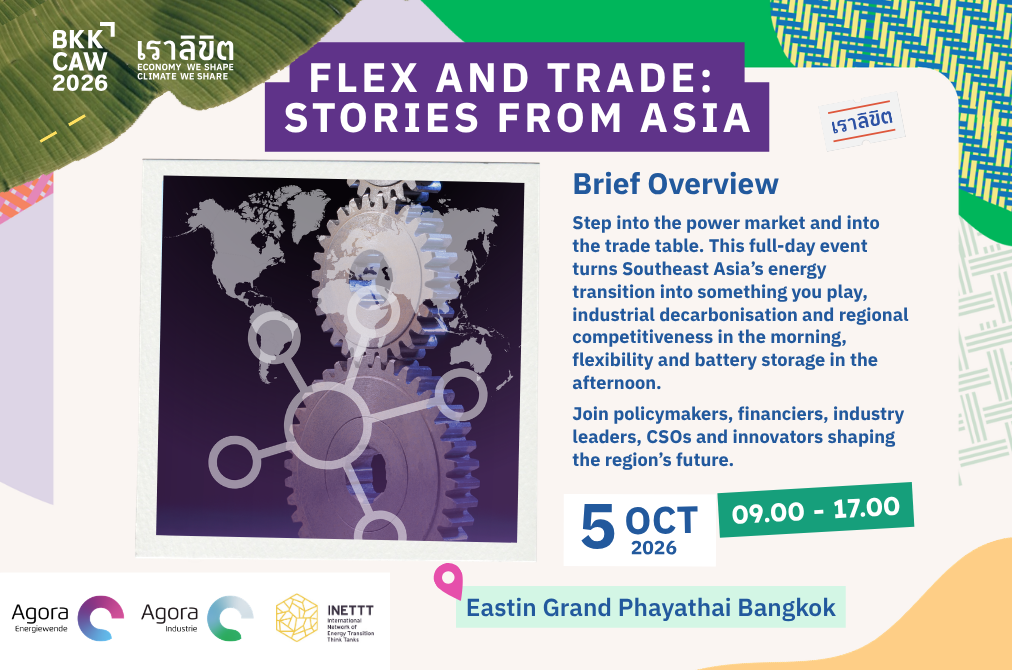
Flex and trade: Stories from Asia
This full-day event brings together policymakers, industry leaders, financiers, civil society, and innovators to explore how power system flexibility, industrial decarbonisation, and regional competitiveness can reinforce one another to accelerate Southeast Asia's just energy transition. Through interactive simulations, expert framing on topics such as battery storage, CBAM, and steel and hydrogen decarbonisation, and facilitated peer discussions, participants will examine the gap between policy ambition and real-world implementation, and identify actionable solutions for aligning power sector transformation with low-carbon industrial development across the region.
05/10/2026 • 09:00
Eastin Grand Hotel Phayathai
Flex and trade: Stories from Asia
This full-day event brings together policymakers, industry leaders, financiers, civil society, and innovators to explore how power system flexibility, industrial decarbonisation, and regional competitiveness can reinforce one another to accelerate Southeast Asia's just energy transition. Through interactive simulations, expert framing on topics such as battery storage, CBAM, and steel and hydrogen decarbonisation, and facilitated peer discussions, participants will examine the gap between policy ambition and real-world implementation, and identify actionable solutions for aligning power sector transformation with low-carbon industrial development across the region.
05/10/2026 • 09:00
Eastin Grand Hotel Phayathai
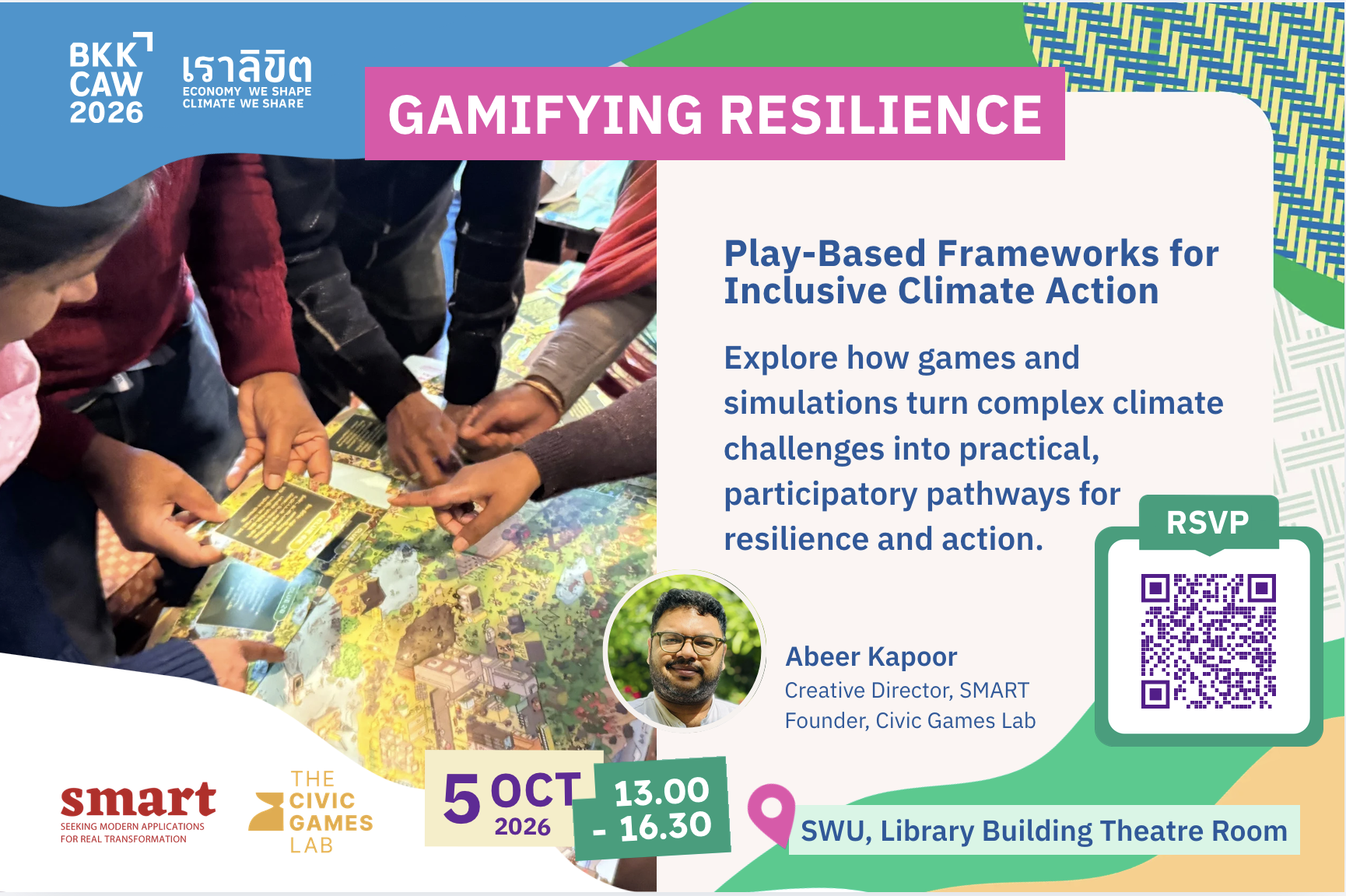
Gamifying Resilience: Play-Based Frameworks for Inclusive Climate Action
Climate action is often communicated through reports, technical frameworks and expert-led training. But communities facing water stress, heat, pollution, livelihood uncertainty and changing governance systems need more than information—they need the agency to understand systems, test choices and shape decisions. Gamifying Resilience is a 90-minute masterclass and manifesto-building session by SMART / Civic Games Lab exploring how games, simulations and participatory formats can become practical frameworks for climate action. The session will showcase field-tested approaches across climate awareness, rural development planning, integrated water management and city-building, demonstrating how complex challenges can be translated into playable systems using roles, cards, maps, budgets, scenarios and dilemmas. Participants will explore how play can enable communities to rehearse decisions, experience trade-offs, negotiate priorities and develop locally relevant pathways for resilience. The session will close with a collective Manifesto for Play-Based Climate Action—asking how play can move from novelty to a serious tool for inclusive climate planning and action.
05/10/2026 • 13:00
SWU, Library Building Theatre Room
Gamifying Resilience: Play-Based Frameworks for Inclusive Climate Action
Climate action is often communicated through reports, technical frameworks and expert-led training. But communities facing water stress, heat, pollution, livelihood uncertainty and changing governance systems need more than information—they need the agency to understand systems, test choices and shape decisions. Gamifying Resilience is a 90-minute masterclass and manifesto-building session by SMART / Civic Games Lab exploring how games, simulations and participatory formats can become practical frameworks for climate action. The session will showcase field-tested approaches across climate awareness, rural development planning, integrated water management and city-building, demonstrating how complex challenges can be translated into playable systems using roles, cards, maps, budgets, scenarios and dilemmas. Participants will explore how play can enable communities to rehearse decisions, experience trade-offs, negotiate priorities and develop locally relevant pathways for resilience. The session will close with a collective Manifesto for Play-Based Climate Action—asking how play can move from novelty to a serious tool for inclusive climate planning and action.
05/10/2026 • 13:00
SWU, Library Building Theatre Room
MAIN STAGE | Day 2 | Signals from the Future: What’s Emerging?
Better, alternative economies are not fiction, but an ever-present reality across the region. NE pioneers will share lessons from their experience about the necessary conditions to grow a better economy, the obstacles that stands in the way, and how these may be overcome. New trends and technological possibilities are explored while highlighting the enduring relevance of cultural heritage, local wisdom, traditional practices, and indigenous knowledge. Each evening on the main stage, we feature the following: 🎭 Art & Culture Performance (15 min) A showcase celebrating Thailand's Climate Story — 7 Regions, 1 Action. Embracing local wisdom and modern creativity. 📋 BKKCAW recap of the day (15 min) Key highlights, moments and takeaways from today's BKKCAW sessions across the city. 💬 Q&A (10 min) Your questions answered by today's speakers and programme team. 🌀 Theme Wrap-Up (10 min) Reflecting on today's panel discussions and a preview of what's coming tomorrow. 🎵 Climate Concert (1 Hour) Music, art and community energy to close the evening, where sound and culture meet climate action.
05/10/2026 • 16:30
Lumphini Park
MAIN STAGE | Day 2 | Signals from the Future: What’s Emerging?
Better, alternative economies are not fiction, but an ever-present reality across the region. NE pioneers will share lessons from their experience about the necessary conditions to grow a better economy, the obstacles that stands in the way, and how these may be overcome. New trends and technological possibilities are explored while highlighting the enduring relevance of cultural heritage, local wisdom, traditional practices, and indigenous knowledge. Each evening on the main stage, we feature the following: 🎭 Art & Culture Performance (15 min) A showcase celebrating Thailand's Climate Story — 7 Regions, 1 Action. Embracing local wisdom and modern creativity. 📋 BKKCAW recap of the day (15 min) Key highlights, moments and takeaways from today's BKKCAW sessions across the city. 💬 Q&A (10 min) Your questions answered by today's speakers and programme team. 🌀 Theme Wrap-Up (10 min) Reflecting on today's panel discussions and a preview of what's coming tomorrow. 🎵 Climate Concert (1 Hour) Music, art and community energy to close the evening, where sound and culture meet climate action.
05/10/2026 • 16:30
Lumphini Park
Powering a safe and just renewable energy transition
Southeast Asia is scaling renewable energy at speed, and it should. But megawatts, mobilized capital, and avoided emissions do not tell us whether the transition is shaping a better future system – one that protects people and ecosystems, keeps energy affordable and reliable, shares costs and benefits fairly, earns social license, and takes responsibility for materials across their life cycle. This session treats ecological safety and social justice as the foundations for future systems that create enduring energy resilience. It draws lessons from the Responsible Energy Initiative - Philippines (REI PH), a multi-sector, collaborative action platform that Forum for the Future (Forum) and local partners convene to advance responsible renewable energy production and deployment. Thailand offers a contrasting market, with its own debate over imported power and gas dependence. Using both countries as complementary lenses through which to view the energy transition, the session moves from diagnosis to design and convenes the change-makers who could carry this work into new national contexts in Southeast Asia. The objectives of the session are: › Reframe ecological safety and social justice as the basis of a legitimate, resilient, and durable energy transition, not a compliance overlay. › Show a working model: what REI PH has learned in the Philippines, and how it could adapt to Thailand and beyond. › Identify concrete risks to avoid, enabling conditions, and near-term actions. › Convene the partners and funders who could extend safe and just RE programs to new national contexts.
05/10/2026 • 13:00
Ivory I & II, COMO Metropolitan Bangkok
Powering a safe and just renewable energy transition
Southeast Asia is scaling renewable energy at speed, and it should. But megawatts, mobilized capital, and avoided emissions do not tell us whether the transition is shaping a better future system – one that protects people and ecosystems, keeps energy affordable and reliable, shares costs and benefits fairly, earns social license, and takes responsibility for materials across their life cycle. This session treats ecological safety and social justice as the foundations for future systems that create enduring energy resilience. It draws lessons from the Responsible Energy Initiative - Philippines (REI PH), a multi-sector, collaborative action platform that Forum for the Future (Forum) and local partners convene to advance responsible renewable energy production and deployment. Thailand offers a contrasting market, with its own debate over imported power and gas dependence. Using both countries as complementary lenses through which to view the energy transition, the session moves from diagnosis to design and convenes the change-makers who could carry this work into new national contexts in Southeast Asia. The objectives of the session are: › Reframe ecological safety and social justice as the basis of a legitimate, resilient, and durable energy transition, not a compliance overlay. › Show a working model: what REI PH has learned in the Philippines, and how it could adapt to Thailand and beyond. › Identify concrete risks to avoid, enabling conditions, and near-term actions. › Convene the partners and funders who could extend safe and just RE programs to new national contexts.
05/10/2026 • 13:00
Ivory I & II, COMO Metropolitan Bangkok
Powering Growth, Polluting Communities
Across Asia, communities are increasingly raising concerns about the air pollution and public health impacts associated with gas-fired power plants. While these projects are often presented as part of the energy transition, affected communities continue to face questions around air quality, environmental monitoring, public participation, and accountability. Many organisations across the region are working on similar challenges, but opportunities for cross-border learning and collaboration remain limited. This event will bring together community advocates, civil society organisations, researchers, and campaigners from Asia to share experiences and lessons from campaigns addressing gas-power pollution and community health impacts. Through a short panel discussion and breakout sessions, participants will explore how communities are responding to pollution concerns, compare approaches to monitoring and accountability, and identify opportunities for collaboration. Interpretation will be available between Thai and English at this event. Registrations are required to attend.
05/10/2026 • 13:30
Powering Growth, Polluting Communities
Across Asia, communities are increasingly raising concerns about the air pollution and public health impacts associated with gas-fired power plants. While these projects are often presented as part of the energy transition, affected communities continue to face questions around air quality, environmental monitoring, public participation, and accountability. Many organisations across the region are working on similar challenges, but opportunities for cross-border learning and collaboration remain limited. This event will bring together community advocates, civil society organisations, researchers, and campaigners from Asia to share experiences and lessons from campaigns addressing gas-power pollution and community health impacts. Through a short panel discussion and breakout sessions, participants will explore how communities are responding to pollution concerns, compare approaches to monitoring and accountability, and identify opportunities for collaboration. Interpretation will be available between Thai and English at this event. Registrations are required to attend.
05/10/2026 • 13:30
Surviving the City: Climate Risks, Energy Choices, Our Future
We have been living with increasingly extreme weather for more than a decade—but how much has Bangkok already changed, and what comes next? How much hotter could the city become? How much flooding should we prepare for? And what needs to change for Bangkok to remain liveable? Surviving the City invites you to explore these questions through a four-part immersive data visualization. Follow Bangkok’s extreme weather patterns from the past to the present and into the future, and explore how climate impacts affect people differently depending on where and how they live. Then, discover the possibilities for the energy system that keeps the city running. Where does our energy come from today? What choices do we have? And how could a cleaner, more resilient energy system help shape the future of our city? Let’s find out what the data tells us about the city we live in and adaptation we need! 📍 One Bangkok, B1 floor 📅 5–11 October 2026
05/10/2026 • 09:00
One Bangkok
Surviving the City: Climate Risks, Energy Choices, Our Future
We have been living with increasingly extreme weather for more than a decade—but how much has Bangkok already changed, and what comes next? How much hotter could the city become? How much flooding should we prepare for? And what needs to change for Bangkok to remain liveable? Surviving the City invites you to explore these questions through a four-part immersive data visualization. Follow Bangkok’s extreme weather patterns from the past to the present and into the future, and explore how climate impacts affect people differently depending on where and how they live. Then, discover the possibilities for the energy system that keeps the city running. Where does our energy come from today? What choices do we have? And how could a cleaner, more resilient energy system help shape the future of our city? Let’s find out what the data tells us about the city we live in and adaptation we need! 📍 One Bangkok, B1 floor 📅 5–11 October 2026
05/10/2026 • 09:00
One Bangkok
Talent, Purpose, and the Asia Decade: Investing in Asia's Climate Talent
Every practitioner in this field has had the same moment: a project ready to go, except nobody on the team has the technical experience in storage systems, climate risk modelling, or offtake negotiation to take it forward. It's not a one-off — global demand for green talent is growing roughly twice as fast as supply, and by 2030 as many as one in five climate roles could go unfilled. With Asia's energy systems already strained by a global crisis and a looming super El Niño, closing this gap requires the urgency this decade actually demands. Bringing together funders, climate organisations, and talent partners, the session will explore where talent needs are sharpest, especially among CSOs, how funders can plug into closing them, and what it's really like to move into a climate career, or upskill within one – drawing on the perspectives of people who've made that transition. The evening closes with networking over food and drinks. This event is by invitation only.
05/10/2026 • 17:00
Glowfish Sathorn
Talent, Purpose, and the Asia Decade: Investing in Asia's Climate Talent
Every practitioner in this field has had the same moment: a project ready to go, except nobody on the team has the technical experience in storage systems, climate risk modelling, or offtake negotiation to take it forward. It's not a one-off — global demand for green talent is growing roughly twice as fast as supply, and by 2030 as many as one in five climate roles could go unfilled. With Asia's energy systems already strained by a global crisis and a looming super El Niño, closing this gap requires the urgency this decade actually demands. Bringing together funders, climate organisations, and talent partners, the session will explore where talent needs are sharpest, especially among CSOs, how funders can plug into closing them, and what it's really like to move into a climate career, or upskill within one – drawing on the perspectives of people who've made that transition. The evening closes with networking over food and drinks. This event is by invitation only.
05/10/2026 • 17:00
Glowfish Sathorn
What The Plans Miss: Women and Asia's Climate & Energy Justice Plans
Women are living the Just Energy Transition amid its conflicts. Why aren't they leading it?" Across Asia and the Pacific, 385 national energy policies were reviewed. Only 16 were centered on gender. In the meantime, most of the energy ministries in the region are still led by men. Asia's energy systems are evolving rapidly and the existing inequalities are determining who carries the costs of that change and who receives its benefits. Women are living through those resource distributions and working to shift this reality. This work is rarely present where the plans are written and the conversations that produce the plans remain largely technical. Join Sath-CSIDC at Bangkok Climate Action Week as we address this gap by moving women's knowledge and leadership from the margins to the centre of climate and energy discourse and build intentional relationships between practitioners working on these questions across the region to foster collaboration that continues past the session. Hear from an all women-panel with a diverse expertise in research, advocacy, community training, climate finance and movement organising and then join breakout groups to build the relationships and ideas that outlast the session. This isn't a room to sit and listen. It's a room to build in. Who is This For: Organizers, Researchers, Gender/JET Professionals, Energy Experts, Funders, Policy Experts, Justice-oriented Social Organizations, Regional and International Development Organizations Please register via the QR code! it will take even less than 2 minutes! In partnership with: Kai Impact Advisory (KAI Advisory), Philanthropy Dialogues, Asian People’s Movement and Debt & Development (APMDD), Mee Panyar & Asian-Pacific Resource & Research Centre for Women (ARROW)
05/10/2026 • 13:00
Chulalongkorn University: Chaloem Rajakumari 60 Building
What The Plans Miss: Women and Asia's Climate & Energy Justice Plans
Women are living the Just Energy Transition amid its conflicts. Why aren't they leading it?" Across Asia and the Pacific, 385 national energy policies were reviewed. Only 16 were centered on gender. In the meantime, most of the energy ministries in the region are still led by men. Asia's energy systems are evolving rapidly and the existing inequalities are determining who carries the costs of that change and who receives its benefits. Women are living through those resource distributions and working to shift this reality. This work is rarely present where the plans are written and the conversations that produce the plans remain largely technical. Join Sath-CSIDC at Bangkok Climate Action Week as we address this gap by moving women's knowledge and leadership from the margins to the centre of climate and energy discourse and build intentional relationships between practitioners working on these questions across the region to foster collaboration that continues past the session. Hear from an all women-panel with a diverse expertise in research, advocacy, community training, climate finance and movement organising and then join breakout groups to build the relationships and ideas that outlast the session. This isn't a room to sit and listen. It's a room to build in. Who is This For: Organizers, Researchers, Gender/JET Professionals, Energy Experts, Funders, Policy Experts, Justice-oriented Social Organizations, Regional and International Development Organizations Please register via the QR code! it will take even less than 2 minutes! In partnership with: Kai Impact Advisory (KAI Advisory), Philanthropy Dialogues, Asian People’s Movement and Debt & Development (APMDD), Mee Panyar & Asian-Pacific Resource & Research Centre for Women (ARROW)
05/10/2026 • 13:00
Chulalongkorn University: Chaloem Rajakumari 60 Building
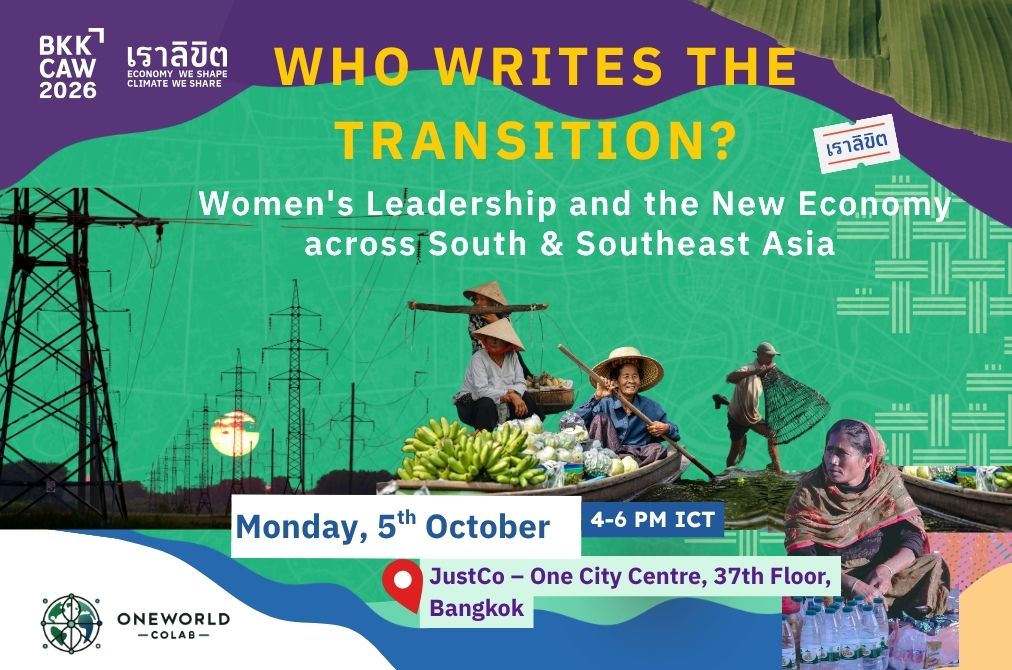
Who Writes the Transition? Women's Leadership and the New Economy across South and Southeast Asia
Oneworld Colab brings together a panel discussion centered around a single question: What does a gender-just transition across South and Southeast Asia actually require, and who gets to design and finance it? Moderated by Moutushi Sengputa (Founder, Oneworld Colab) bringing expertise in climate finance and community-led clean energy action, the panel brings together a diverse cohort of partner organizations; Haqdarshak on social protection and last-mile welfare delivery, Heifer International on food systems and rural livelihoods, ARROW on rights and intergenerational policy advocacy, and PEKKA on grassroots collective economy and women’s leadership. Senior leaders from each organisation will speak directly from their communities’ frontline realities in a structured dialogue. The discussion is followed by The Weave, a facilitated connection space designed to seed new institutional links between South and Southeast Asian organisations.
05/10/2026 • 16:00
JustCo- One City Centre
Who Writes the Transition? Women's Leadership and the New Economy across South and Southeast Asia
Oneworld Colab brings together a panel discussion centered around a single question: What does a gender-just transition across South and Southeast Asia actually require, and who gets to design and finance it? Moderated by Moutushi Sengputa (Founder, Oneworld Colab) bringing expertise in climate finance and community-led clean energy action, the panel brings together a diverse cohort of partner organizations; Haqdarshak on social protection and last-mile welfare delivery, Heifer International on food systems and rural livelihoods, ARROW on rights and intergenerational policy advocacy, and PEKKA on grassroots collective economy and women’s leadership. Senior leaders from each organisation will speak directly from their communities’ frontline realities in a structured dialogue. The discussion is followed by The Weave, a facilitated connection space designed to seed new institutional links between South and Southeast Asian organisations.
05/10/2026 • 16:00
JustCo- One City Centre